FREE SHIPPING BOTH WAYS
ON EVERY ORDER!
LIST PRICE:
$54.00

OUR PRICE:
$42.77

You may extend rentals at any time.


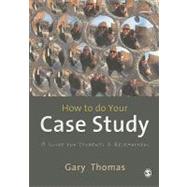
How to Do Your Case Study : A Guide for Students and Researchers
ISBN: 9780857025630 | 0857025635
Format: Paperback
Publisher: SAGE Publications Ltd
Pub. Date: 1/19/2011

Why Rent from Knetbooks?

Because Knetbooks knows college students. Our rental program is designed to save you time and money. Whether you need a textbook for a semester, quarter or even a summer session, we have an option for you. Simply select a rental period, enter your information and your book will be on its way!

Top 5 reasons to order all your textbooks from Knetbooks:

  • We have the lowest prices on thousands of popular textbooks
  • Free shipping both ways on ALL orders
  • Most orders ship within 48 hours
  • Need your book longer than expected? Extending your rental is simple
  • Our customer support team is always here to help
SummaryTable of ContentsAuthor Biography
In this lucid, accessible and often witty new text, Gary Thomas introduces students and researchers to the basics of case study research.

'This very readable and well crafted book should significantly advance thinking about the conduct of case study research. It impressively demonstrates, through well-selected examples, the uses of case studies within a wide range of disciplines and practical fields of study and dispels some popular misconceptions of this research genre in the process.' - John Elliot - Emeritus Pro... MORE
Prefacep. xi
Getting your bearingsp. 1
What is a case study?p. 3
Is the case study scientific?p. 7
Some definitionsp. 9
What is a case?p. 11
What is and is not a case?p. 14
What is the case study good and not good for?p. 17
If you take only one thing from this chapter, take this ...p. 23
Further read... MOREp. 23
Case study and research designp. 25
Doing the right kind of researchp. 25
What is design?p. 26
First things first: your purposep. 27
Next, your questionp. 28
How to go from idea to question to case studyp. 31
Questions and different approaches to researchp. 35
Design frames and methodsp. 37
Using storyboards to help you design your case studyp. 38
If you take only one thing from this chapter, take this ...p. 43
Further readingp. 44
Models of the wholep. 45
Why am I reading this chapter?p. 45
Break things down or see them as wholes?p. 45
Gestalt psychologyp. 49
Dramas, theatres and stagesp. 50
Ecological psychologyp. 52
Systems thinkingp. 55
If you take only one thing from this chapter, take this ...p. 59
Further readingp. 59
Ensuring quality in your case study: what's important?p. 61
Is the 'sample' important?p. 61
Do I have to worry about reliability and validity in a case study?p. 62
Qualityp. 66
Ethicsp. 68
If you take only one thing from this chapter, take this ...p. 71
Further readingp. 71
Getting down to doing itp. 73
Kinds of case studies: finding your casep. 75
How do you find your case?p. 75
Same starting points, different paths - there's no right wayp. 89
Kinds of case studiesp. 90
If you take only one thing from this chapter, take this ...p. 95
Further readingp. 96
Your purposep. 97
Intrinsicp. 98
Instrumentalp. 98
Evaluativep. 99
Explanatoryp. 101
Exploratoryp. 104
If you take only one thing from this chapter, take this ...p. 109
Further readingp. 109
Your approachp. 111
Building a theoryp. 112
Testing a theoryp. 115
Drawing a picture - illustrative-demonstrativep. 118
Interpretativep. 124
Experimentalp. 129
If you take only one thing from this chapter, take this ...p. 134
Further readingp. 135
Your processp. 137
The single casep. 138
The multiple or collective or comparative case (or cross-case analysis)p. 141
Retrospectivep. 145
The snapshotp. 146
Diachronic studiesp. 149
Nested case studiesp. 152
Parallel and sequential studiesp. 155
If you take only one thing from this chapter, take this ...p. 157
Further readingp. 158
Getting on with it and finishingp. 159
Out in the field: some ways to collect data and evidencep. 161
Interviewsp. 162
Accountsp. 163
Diariesp. 164
Group interviews and focus groupsp. 164
Interrogating documentsp. 164
Questionnairesp. 165
Observationp. 165
Image-based methodsp. 166
Measurements and testsp. 167
Official statistics and other numerical datap. 167
If you take only one thing from this chapter, take this ...p. 168
Further readingp. 168
A toolkit for analysing and thinkingp. 170
Constant comparative method: eliciting themesp. 171
Systems thinkingp. 173
Drawing storyboards - the nuts and boltsp. 176
Developing your theoryp. 178
Using narrativep. 184
Think dramap. 188
Being intuitive and imaginativep. 190
If you take only one thing from this chapter, take this ...p. 192
Further readingp. 193
Writing your studyp. 194
Structurep. 194
Writing up your case studyp. 196
Some rules for writersp. 202
If you take only one thing from tins chapter, take this ...p. 205
Further readingp. 205
The fancy stuff: generalisation, induction, abduction, phronesis and theoryp. 206
What can the case study tell us?p. 206
Generalisation - is the case study really all that bad?p. 210
Finding or regularisingp. 215
If you take only one thing from this chapter, take this ...p. 216
... and this - a final final thoughtp. 217
Further readingp. 217
Other readingp. 218
Referencesp. 219
Indexp. 225
Table of Contents provided by Ingram. All Rights Reserved.
Gary Thomas is Professor of Education at the University of Birmingham. He has received awards from the ESRC, the Nuffield Foundation, the Leverhulme Trust, national and local government, and a number of charities for research and inquiry on a wide range of topics.


Please wait while this item is added to your cart...

