FREE SHIPPING BOTH WAYS
ON EVERY ORDER!
LIST PRICE:
$27.50

OUR PRICE:
$7.90

You may extend rentals at any time.


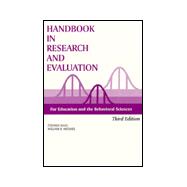
Handbook in Research and Evaluation: A Collection of Principles, Methods, and Strategies Useful...

ISBN: 9780912736327 | 0912736321
Edition: 3rd
Format: Paperback
Publisher: Edits Pub
Pub. Date: 3/1/1995

Why Rent from Knetbooks?

Because Knetbooks knows college students. Our rental program is designed to save you time and money. Whether you need a textbook for a semester, quarter or even a summer session, we have an option for you. Simply select a rental period, enter your information and your book will be on its way!

Top 5 reasons to order all your textbooks from Knetbooks:

  • We have the lowest prices on thousands of popular textbooks
  • Free shipping both ways on ALL orders
  • Most orders ship within 48 hours
  • Need your book longer than expected? Extending your rental is simple
  • Our customer support team is always here to help
Table of Contents
Educational Inquiry
1(7)
Characteristics of scientific inquiry
1(1)
Three modes of educational inquiry
... MORE
2(4)
References
6(1)
Planning Evaluation Studies
7(28)
Research and evaluation-two disciplines
8(2)
Program evaluation in a nutshell
10(2)
Models for program evaluation
12(1)
The CIPP model
12(8)
Metfessel-Michael paradigm for evaluation of school programs
20(4)
Needs assessment
24(2)
Practical Guidelines to Needs Assessment
26(6)
References
32(3)
Planning Research Studies
35(10)
Formulation of the problem
36(1)
Steps in preparing a research investigation
36(1)
Ten steps in planning good research
37(1)
Advantages of a pilot study
38(1)
Common mistakes made by graduate students
39(5)
Planning for computer analysis and data processing
44(1)
References
44(1)
Guide to Traditional Research Designs, Methods, and Strategies
45(60)
Nine basic methods of research
46(2)
Basic steps in the planning and conduct of research
48(1)
Historical research
48(2)
Descriptive research
50(1)
Developmental research
51(1)
Case and field study research
52(1)
Correlational research
53(1)
Causal-comparative research
54(2)
True experimental research
56(2)
Quasi-experimental research
58(1)
Action research
59(1)
Differences among formal educational research, action research, and the casual approach to problem solving
60(3)
Cohort analysis
63(1)
Single subject experiments
63(3)
Overview: internal and external validity in an experimental design
66(1)
Internal validity
67(2)
External validity
69(1)
Examples of eight experimental designs
70(1)
A ``poor'' research design: the ``one-shot case study''
70(1)
Design 2-One-group pretest-posttest design
71(1)
Design 4-Randomized control-group pretest-posttest design
72(2)
Design 5-Randomized Solomon four-group design
74(1)
Design 6-Randomized control-group posttest only design
75(1)
Design 10-Nonrandomized control-group pretest-posttest design
76(1)
Design 11-Counterbalanced design
77(1)
Design 7-One-group time-series design
78(1)
Design 14-Control-group time-series design
79(1)
Factors jeopardizing the validity of experimental designs
80(1)
An extension of the work of Campbell and Stanley
80(2)
Factorial designs
82(1)
The 2 x 2 factorial design
83(1)
Extended factorial designs
84(1)
Additional concerns, strategies, and pitfalls in the design of research
85(1)
Control-a key concept in experimental design
86(1)
Confounding and cancellation of effects: two pitfalls of interaction
87(1)
Generalizability of research findings
88(1)
Interaction between variables
89(1)
Some common sources of error
90(2)
Making meaningful comparisons
92(3)
Reactive versus nonreactive measures
95(2)
Measurement: single versus multiple outcomes-triangulation
97(1)
Statistical regression effects
98(1)
Short-term and long-term studies
99(1)
Five points about research design
100(1)
Two statistical points
100(1)
Large samples versus small samples
101(1)
Individual differences
102(1)
Matching as a control technique: some disadvantages
103(1)
References
104(1)
Instrumentation and Measurement
105(58)
A form for evaluating tests
106(1)
Chart comparing various test scores
107(1)
Interpreting test scores
108(5)
Reference populations-norm groups
113(1)
Comparing norm-referenced with criterion-referenced tests
113(3)
References
116(1)
The relationship between type of test and classroom instruction
116(1)
Performance-based (authentic) assessment
117(2)
The Rasch Scaling Model
119(2)
References
121(1)
The Delphi Technique (reaching group consensus individually)
122(1)
References
123(1)
Item analysis
123(1)
References
124(1)
Three types of validity
125(1)
Test Item Bias
126(1)
Reference
127(1)
Validity
128(3)
References
131(3)
Reliability
134(2)
References
136(1)
Survey design and techniques for school-related use
136(4)
References
140(1)
The mailed questionnaire
141(4)
The research interview
145(3)
Attitude scaling
148(2)
References
150(1)
Graphic rating scales
150(2)
The semantic differential
152(4)
Kinds of tests and measurements commonly used
156(1)
The role of measurement in program evaluation: some perspectives
156(2)
Multiple criterion measures for evaluation of school programs: Metfessel and Michael
158(5)
Statistical Techniques and the Analysis of Data
163(54)
Overview of statistical methods
164(1)
Measures of central tendency and variability
165(1)
Frequency distribution
166(2)
Scatter diagrams, scattergrams, scatter plots
168(1)
The analysis of crossbreaks
169(1)
Computing Guide 1-Determining percentile equivalents graphically
170(2)
Computing Guide 2-Determining the mean and standard deviation for ungrouped data
172(1)
Computing Guide 3-Determining the mean and standard deviation for grouped data
173(1)
Appropriate correlational techniques for different forms of variables
174(1)
References
175(1)
Computing Guide 4-The product-moment correlation coefficient (Pearson r)
176(1)
Computing Guide 5-Rank-difference correlation (Spearman rho)
177(1)
Computing Guide 6-The point-biserial correlation coefficient for data where one variable is a true dichotomy and the other variable is continuously distributed
178(1)
Computing Guide 7-Use of the Spearman-Brown formula to estimate reliability after a test is lengthened or shortened
179(1)
Computing Guide 8-Hypothetical item score matrix of 10 examinees (A, B,..., J) in a four-item total test preliminary to obtaining an internal-consistency estimate of reliability
179(1)
Computing Guide 9-Hypothetical item score matrix of 8 examinees (A, B,..., H) in a five-item attitude scale involving five levels of response (1, 2, 3, 4, or 5) preliminary to obtaining an internal-consistency estimate of reliability
180(1)
Computing Guide 10-The z test, or critical ratio, to determine a significant difference between two sample means, (large samples)
181(2)
Computing Guide 11-The t test, or critical ratio, to determine a significant difference between two sample means, (satisfactory for large samples; particularly appropriate for small samples)
183(1)
Chi square
184(1)
Computing Guide 12-Chi square for a 2 x 2 table
185(1)
Computing Guide 13-Median test for a difference between two medians
186(1)
Computing Guide 14-Chi square for categories exceeding a 2 x 2 table
187(2)
Analysis of variance
189(2)
Analysis of covariance
191(1)
Analysis of variance and covariance and computer programs
191(1)
Multivariate statistical procedures
191(1)
Hypothesis testing and statistical significance
192(4)
The search for promising practices: avoiding the Type II error
196(1)
Sampling
197(5)
Ways of interpreting correlation coefficients
202(4)
The problem of hits and misses in predictive validity
206(2)
Meta-analysis and effect size
208(2)
Multivariate statistical procedures
210(1)
Multiple regression analysis
210(1)
Discriminant function analysis
210(1)
Canonical analysis
211(1)
Factor analysis
212(1)
General references in statistics
213(1)
Experimental design
213(1)
Multivariate statistical procedures
214(3)
Naturalistic/Qualitative Evaluation Methodology
217(8)
Naturalistic, ethnographic, and qualitative research methods defined
218(1)
Traditional and naturalistic methodologies compared
218(1)
Fifteen attributes of naturalistic inquiry
219(2)
Building trustworthiness into naturalistic studies
221(1)
Overview of naturalistic criteria
222(1)
Purposeful sampling
223(1)
References
224(1)
Stating Cognitive and Affective Objectives
225(12)
Writing behavioral objectives
225(3)
Summary of the taxonomy of educational objectives-cognitive & affective domains
228(7)
Reference
235(2)
Criteria and Guidelines for Planning, Preparing, Writing, and Evaluating the Research Proposal, Report, Thesis, or Article
237(10)
Form for the evaluation of an article
238(1)
A research proposal: a checklist of items for possible inclusion
239(2)
Criteria for evaluation of a research report, article, or thesis
241(3)
Research methodology-a dissenting view
244(1)
References
245(2)
Appendix of Statistical Tables247(6)
INDICES, Author and Subject253


Please wait while this item is added to your cart...