FREE SHIPPING BOTH WAYS
ON EVERY ORDER!
LIST PRICE:
$33.20

OUR PRICE:
$11.50

You may extend rentals at any time.


Fundamentals of English Grammar, Volume A
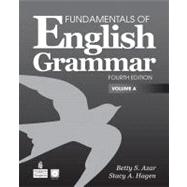
ISBN: 9780131383531 | 0131383531
Edition: 4th
Format: Paperback
Publisher: Pearson Education ESL
Pub. Date: 2/10/2011

Why Rent from Knetbooks?

Because Knetbooks knows college students. Our rental program is designed to save you time and money. Whether you need a textbook for a semester, quarter or even a summer session, we have an option for you. Simply select a rental period, enter your information and your book will be on its way!

Top 5 reasons to order all your textbooks from Knetbooks:

  • We have the lowest prices on thousands of popular textbooks
  • Free shipping both ways on ALL orders
  • Most orders ship within 48 hours
  • Need your book longer than expected? Extending your rental is simple
  • Our customer support team is always here to help
SummaryTable of Contents
A classic developmental skills text for lower-intermediate and intermediate English language learners, Fundamentals of English Grammar is a comprehensive reference grammar as well as a stimulating and teachable classroom text. (Volume A contains Chapters 1-8.) While keeping the same basic approach and material as in earlier editions, the fourth edition more fully develops communicative and interactive language-learning activities. Some of the new features are: Innovative Warm-Up exercises that precede the grammar charts and introduce points to ... MORE


Chapter 1         Present Time

1-1      Simple present and present progressive

1-2      Forms of the simple present and present progressive

1-3      Frequency adverbs

1-4      Singular/plural

... MORE

1-6      Non-action verbs

1-7      Present verbs: short answers to yes/no questions


Chapter 2         Past Time

2-1      Expressing past rime: the simple past

2-2      Spelling of –ing and –ed forms

2-3      The principal parts of a verb

2-4      Common irregular verbs: a reference list

2-5      Regular verbs: pronunciation of –ed endings

2-6      Simple past and past progressive

2-7      Expressing past time: using time clauses

2-8      Expressing past habit: used to


Chapter 3         Future Time

3-1      Expressing future time: be going to and will

3-2      Forms with be going to

3-3      Forms with will

3-4      Certainty about the future

3-5      Be going to vs. will

3-6      Expressing the future in time clauses and if -clauses

3-7      Using the present progressive to express future time

3-8      Using the simple present to express future time

3-9      Immediate future: using be about to

3-10    Parallel verbs


Chapter 4         Present Perfect and the Past Perfect

4-1      Past participle

4-2      Present perfect with since and for

4-3      Negative, question, and short-answer forms

4-4      Present perfect with unspecified time

4-5      Simple past vs. present perfect

4-6      Present perfect progressive

4-7      Present perfect progressive vs. present perfect

4-8      Past perfect


Chapter 5         Asking Questions

5-1      Yes/no questions and short answers

5-2      Yes/no and information questions

5-3      Where, why, when, what time, how come, what…for

5-4      Questions with who, who ( m ) , and what

5-5      Using what + a form of do

5-6      Using which and what kind of

5-7      Using whose

5-8      Using how

5-9      Using how often

5-10    Using how far

5-11    Length of time: it + take and how long

5-12    Spoken and written contractions with question words

5-13    More questions with how

5-14    Using how about and what about

5-15    Tag questions


Chapter 6         Nouns and Pronouns

6-1      Plural forms of nouns

6-2      Pronunciation of final –s/-es

6-3      Subjects, verbs, and objects

6-4      Objects of prepositions

6-5      Prepositions of time

6-6      Word order: place and time

6-7      Subject-verb agreement

6-8      Using adjectives to describe nouns

6-9      Using nouns as adjectives

6-10    Personal pronouns: subjects and objects

6-11    Possessive nouns

6-12    Possessive pronouns and adjectives

6-13    Reflexive nouns

6-14    Singular forms of other : another vs. the other

6-15    Plural forms of other : other ( s ) vs. the other ( s )

6-16    Summary of forms of other


Chapter 7         Modal Auxiliaries

7-1      The form of modal auxiliaires

7-2      Expressing ability: can and could

7-3      Expressing possibility: may, might, and maybe ;

            Expressing permission: may and can

7-4      Using could to express possibility

7-5      Polite questions: may I, could I, can I

7-6      Polite questions: would you, could you, will you, can you

7-7      Expressing advice: should and ought to

7-8      Expressing advice: had better

7-9      Expressing necessity: have to, have got to, must

7-10    Expressing lack of necessity: do not have to;

            Expressing prohibition: must not

7-11    Making logical conclusions: must

7-12    Tag questions with modal auxiliaries

7-13    Giving instructions: imperative questions

7-14    Making suggestions: let’s and why don’t

7-15    Stating preferences: prefer, like … better, would rather


Appendix        Supplementary Grammar Charts


Unit A: A-1  The present perfect vs. the past perfect

                        A-2  The past progressive vs. the past perfect

                        A-3  Still vs. anymore

                        A-4  Additional verbs followed by that -clauses

                        A-5  Additional expressions with be + that -clauses


Unit B: B-1  Phrasal verbs

                        B-2  Phrasal verbs: a reference list


Unit C:            C-1  Preposition combinations: introduction

                        C-2  Preposition combinations: a reference list


Listening Script

Trivia Answers

Index

Audio CD Tracking List


Please wait while this item is added to your cart...

