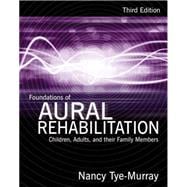
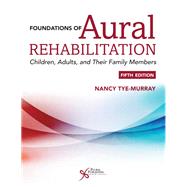
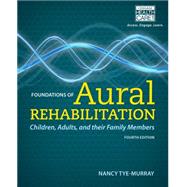
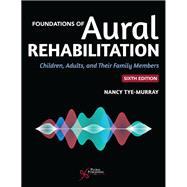
Because Knetbooks knows college students. Our rental program is designed to save you time and money. Whether you need a textbook for a semester, quarter or even a summer session, we have an option for you. Simply select a rental period, enter your information and your book will be on its way!
| Preface | p. vii |
| Introduction | p. 1 |
| The World Health Organization and hearing-related disability | |
| Services included in the aural rehabilitation plan | |
| Where does aural rehabilitation occur? | |
| Who provides aural rehabilitation? | |
| Hearing loss | |
| Service needs | |
| Cost-effectiveness and costs | |
| Evidence-based practice | ... MORE|
| Case study: Evidence-based practice decision making | |
| Speech Recognition and Persons Who Have Hearing Loss | p. 39 |
| Assessing Hearing Acuity and Speech Recognition | p. 41 |
| Review of the audiological examination and the audiogram | |
| Purpose of speech recognition testing | |
| Patient variables | |
| Stimuli units | |
| Test procedures | |
| Difficulties associated with speech recognition assessment | |
| Multicultural issues | |
| Case study: Reason to go with a test battery approach | |
| Listening Devices and Related Technology | p. 87 |
| Hearing aids | |
| Cochlear implants | |
| Assistive listening devices (ALDs) | |
| Case study: Listen to the music | |
| Auditory Training | p. 139 |
| Historical notes | |
| Candidacy for auditory training | |
| Four design principles | |
| Developing analytic training objectives | |
| Developing synthetic training objectives | |
| Formal and informal auditory training | |
| Interweaving auditory training with other components of aural rehabilitation | |
| Auditory training programs | |
| Benefits of auditory training | |
| Case studies: Listening with a new cochlear implant | |
| Speechreading | p. 183 |
| Speechreading for communication | |
| Characteristics of a good lipreader | |
| What happens when someone lipreads? | |
| The difficulty of the lipreading task | |
| What happens when someone speechreads? | |
| Importance of residual hearing | |
| Factors that affect the speechreading process | |
| Oral interpreters | |
| Case study: An exceptional lipreader | |
| Speechreading Training | p. 219 |
| Candidacy | |
| Traditional methods of speechreading training | |
| Developing speechreading skills | |
| Analytic speechreading training objectives | |
| Synthetic speechreading training objectives | |
| Computerized instruction | |
| Efficacy of speechreading training | |
| Case study: Targeting training | |
| Conversation and Communication Behaviors | p. 245 |
| Communication Strategies and Conversational Styles | p. 247 |
| Conversation | |
| Facilitative communication strategies | |
| Repair strategies | |
| Research concerning repair strategies and communication breakdowns | |
| Conversational styles and behaviors | |
| Case study: A couple conversing | |
| Assessment of Conversational Fluency and Communication Difficulties | p. 285 |
| Conversational fluency | |
| General considerations for evaluating conversational fluency and hearing-related disability | |
| Interviews | |
| Questionnaires | |
| Daily logs | |
| Group discussion | |
| Structured communication interactions | |
| Unstructured communication interactions | |
| Case study: A school boy opens up | |
| Communication Strategies Training | p. 317 |
| Self-efficacy | |
| Issues to consider when developing a training program | |
| Getting started | |
| Model for training | |
| Short-term training | |
| Communication strategies training for frequent communication partners | |
| Communication strategies training for children | |
| Benefits of training | |
| Case studies: An increased sense of self-efficacy | |
| Counseling, Psychosocial Support, and Assertiveness Training | p. 349 |
| Who provides counseling, psychosocial support, and assertiveness training? | |
| Counseling | |
| Psychosocial support | |
| Assertiveness training | |
| Related research | |
| Case study: Solving challenging situations | |
| Aural Rehabilitation for Adults | p. 383 |
| Adults Who Have Hearing Loss | p. 385 |
| Prevalence of hearing loss among adults | |
| A patient-centered approach | |
| Characteristics of adult-onset hearing loss | |
| Who is this person? | |
| Where is the person in terms of adjustment to hearing loss? | |
| Case studies: One size doesn't fit all | |
| Aural Rehabilitation Plans for Adults | p. 427 |
| Assessment | |
| Informational counseling | |
| Development of an aural rehabilitation plan | |
| Implementation | |
| Outcomes assessment | |
| Follow-up | |
| Case study: A road map for success | |
| Aural Rehabilitation Plans for Older Adults | p. 479 |
| Activity limitations and participation restrictions | |
| Audiological status and otologic health | |
| Life-situation factors | |
| Physical and cognitive variables | |
| Aural rehabilitation intervention | |
| Aural rehabilitation in the institutional setting | |
| Case study: Staying active | |
| Aural (Re)habilitation for Children | p. 529 |
| Infants and Toddlers Who Have Hearing Loss | p. 531 |
| Detection of hearing loss | |
| Identification and quantification of hearing loss | |
| Health care follow-up | |
| Parent counseling | |
| Early-intervention overview and development of an aural rehabilitation strategy | |
| Communication mode | |
| Listening device | |
| Early-intervention program | |
| Parental support and parent instruction | |
| Case study: A memorable journey | |
| School-Age Children Who Have Hearing Loss | p. 599 |
| Creation of an Individualized Education Plan (IEP) | |
| The multidisciplinary team | |
| School and classroom placement | |
| Amplification and assistive listening devices | |
| Classroom acoustics | |
| Speech, language, and literacy | |
| Other services | |
| Children who have mild or moderate hearing losses | |
| Case studies: IDEA(s) for all | |
| Appendix | p. 666 |
| Glossary | p. 669 |
| References | p. 692 |
| Author Index | p. 758 |
| Subject Index | p. 767 |
| Table of Contents provided by Ingram. All Rights Reserved. |