FREE SHIPPING BOTH WAYS
ON EVERY ORDER!
LIST PRICE:
$101.33

Sorry, this item is currently unavailable.

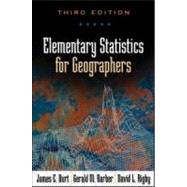
Elementary Statistics for Geographers, Third Edition

ISBN: 9781572304840 | 1572304847
Edition: 3rd
Format: Trade Book
Publisher: The Guilford Press
Pub. Date: 3/19/2009

Why Rent from Knetbooks?

Because Knetbooks knows college students. Our rental program is designed to save you time and money. Whether you need a textbook for a semester, quarter or even a summer session, we have an option for you. Simply select a rental period, enter your information and your book will be on its way!

Top 5 reasons to order all your textbooks from Knetbooks:

  • We have the lowest prices on thousands of popular textbooks
  • Free shipping both ways on ALL orders
  • Most orders ship within 48 hours
  • Need your book longer than expected? Extending your rental is simple
  • Our customer support team is always here to help
SummaryTable of ContentsAuthor Biography
Widely adopted, this uniquely comprehensive text introduces the techniques and concepts of statistics in human and physical geography.
Introduction
Statistics and Geographyp. 3
Statistical Analysis and Geographyp. 8
Datap. 16
Measurement Evaluationp. 28
Data and Informationp. 31
Summaryp. 33
Descriptive Statistics
Displaying and Interpreting Datap. 39
Displaying and Interpretation of the Distributions of Qualitative Variables... MORE
Display and Interpretation of the Distributions of Quantitative Variablesp. 46
Displaying and Interpreting Time-Series Datap. 74
Displaying and Interpreting Spatial Datap. 79
Summaryp. 92
Describing Data with Statisticsp. 95
Measures of Central Tendencyp. 95
Measures of Dispersionp. 109
Higher Order Moments or Other Numerical Measures of the Characteristics of Distributionsp. 117
Using Descriptive Statistics with Time-Series Datap. 118
Descriptive Statistics for Spatial Datap. 124
Summaryp. 147
Review of Sigma Notationp. 148
An Iterative Algorithm for Determining the Weighted or Unweighted Euclidean Medianp. 150
Statistical Relationshipsp. 156
Relationships and Dependencep. 157
Looking for Relationships in Graphs and Tablesp. 158
Introduction to Correlationp. 164
Introduction to Regressionp. 172
Temporal Autocorrelationp. 188
Summaryp. 191
Review of the Elementary Geometry of a Linep. 192
Least Squares Solution via Elementary Calculusp. 194
Inferential Statistics
Random Variables and Probability Distributionsp. 201
Elementary Probability Theoryp. 201
Concept of a Random Variablep. 210
Discrete Probability Distribution Modelsp. 220
Continuous Probability Distribution Modelsp. 233
Bivariate Random Variablesp. 238
Summaryp. 246
Counting Rules for Computing Probabilitiesp. 246
Expected Value and Variance of a Continuous Random Variablep. 250
Samplingp. 254
Why Do We Sample?p. 256
Steps in the Sampling Processp. 257
Types of Samplesp. 260
Random Sampling and Related Probability Designsp. 262
Sampling Distributionsp. 271
Geographic Samplingp. 282
Summaryp. 289
Point and Interval Estimationp. 293
Statistical Estimation Proceduresp. 294
Point Estimationp. 300
Interval Estimationp. 303
Sample Size Determinationp. 315
Summaryp. 318
One-Sample Hypothesis Testingp. 321
Key Steps in Classical Hypothesis Testingp. 321
prob-value Method of Hypothesis Testingp. 333
Hypothesis Tests Concerning the Population Mean m and p<$$$>p. 338
Relationship between Hypothesis Testing and Confidence Interval Estimationp. 345
Statistical Significance versus Practical Significancep. 345
Summaryp. 349
Two-Sample Hypothesis Testingp. 353
Difference of Meansp. 354
Difference of Means for Paired Observationsp. 363
Difference of Proportionsp. 367
The Equality of Variancesp. 369
Summaryp. 373
Nonparametric Methodsp. 376
Comparison of Parametric and Nonparametric Testsp. 377
One- and Two-Sample Testsp. 380
Multisample Kruskal-Wallis Testp. 393
Goodness-of-Fit Testsp. 395
Contingency Tablesp. 405
Estimating a Probability Distribution: Kernel Estimatesp. 408
Bootstrappingp. 418
Summaryp. 427
Analysis of Variancep. 432
The One-Factor, Completely Randomized Designp. 434
The Two-Factor, Completely Randomized Designp. 446
Multiple Comparisons Using the Scheffe Contrastp. 453
Assumptions of the Analysis of Variancep. 455
Summaryp. 457
Derivation of Equation 11-11 from Equation 11-10p. 457
Inferential Aspects of Linear Regressionp. 461
Overview of the Steps in a Regression Analysisp. 461
Assumptions of the Simple Linear Regression Modelp. 465
Inferences in Regression Analysisp. 476
Graphical Diagnostics for the Linear Regression Modelp. 488
Summaryp. 495
Extending Regression Analysisp. 498
Multiple Regression Analysisp. 498
Variable Transformations and the Shape of the Regression Functionp. 514
Validating a Regression Modelp. 525
Summaryp. 528
Patterns in Space and Time
Spatial Patterns and Relationshipsp. 533
Point Pattern Analysisp. 533
Spatial Autocorrelationp. 544
Local Indicators of Spatial Associationp. 559
Regression Models with Spatially Autocorrelated Datap. 566
Geographically Weighted Regressionp. 570
Summaryp. 571
Time Series Analysisp. 577
Time Series Processesp. 578
Properties of Stochastic Processesp. 579
Types of Stochastic Processesp. 584
Removing Trends: Transformations to Stationarityp. 588
Model Identificationp. 590
Model Fittingp. 595
Times Series Models, Running Means, and Filtersp. 601
The Frequency Approachp. 603
Filter Designp. 609
Summaryp. 616
Appendix: Statistical Tablesp. 621
Indexp. 643
About the Authorsp. 653
Table of Contents provided by Ingram. All Rights Reserved.
James E. Burt is Professor and former chair of Geography at the University of Wisconsin-Madison. His current research focuses on development of expert system and statistical approaches for quantitative prediction of soils information.  Gerald M. Barber is Associate Professor of Geography and teaches introductory and advanced courses in statistics at Queen’s University in Kingston, Ontario, Canada. In addition, he is the director of the program in Geographic Information Science and runs the GISLAB. His principal interests are in the application of statistical and optimization models within GIS.

David L. Rigby is Professor of Geography and Statistics at the University of California, Los Angeles. His research interests include regional growth, technological change, evolutionary economic dynamics, and the impacts of globalization and trade on wage inequality.


Please wait while this item is added to your cart...