FREE SHIPPING BOTH WAYS
ON EVERY ORDER!
LIST PRICE:
$102.67

Sorry, this item is currently unavailable.

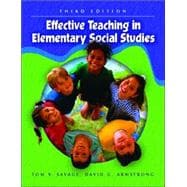
Effective Teaching in Elementary Social Studies
ISBN: 9780130497017 | 0130497010
Edition: 5th
Format: Hardcover
Publisher: Prentice Hall
Pub. Date: 1/1/2004

Why Rent from Knetbooks?

Because Knetbooks knows college students. Our rental program is designed to save you time and money. Whether you need a textbook for a semester, quarter or even a summer session, we have an option for you. Simply select a rental period, enter your information and your book will be on its way!

Top 5 reasons to order all your textbooks from Knetbooks:

  • We have the lowest prices on thousands of popular textbooks
  • Free shipping both ways on ALL orders
  • Most orders ship within 48 hours
  • Need your book longer than expected? Extending your rental is simple
  • Our customer support team is always here to help
SummaryTable of Contents
For Elementary Social Studies Methods courses. Completely rewritten, the fifth edition of this popular text again helps children develop thinking skills and master foundational principles while encouraging them to understand the world, approach challenges from multiple perspectives, and stand firm in the face of injustice. Material focuses on the role of social studies in creating thoughtful, involved citizens and provides an overview of the history of social studies that helps prospective teachers grasp the significance of social studies in th... MORE
PART 1 BACKGROUND, PURPOSES, AND CONTENT
Defining the Social Studies
3(34)
Characteristics of the Field
... MORE(7)
Citizenship Education
12(1)
Global-Awareness Education
13(2)
History and Social Science Education
15(1)
Reflective Thinking and Problem-Solving Education
15(1)
Common Emphasas
16(3)
Emphases Within Citizenship Education
16(1)
Emphases Within Global-Awareness Education
17(1)
Emphases Within History and Social Science Education
17(1)
Emphases Within Reflective-Thinking and Problem-Solving Education
18(1)
Putting It All Together
19(1)
Ten Thematic Strands
19(7)
Culture
19(1)
Time, Continuity, and Change
19(1)
People, Places, and Environments
20(1)
Individual Development and Identity
20(1)
Individuals, Groups, and Institutions
21(1)
Power, Authority, and Governance
21(2)
Production, Distribution, and Consumption
23(1)
Science, Technology, and Society
23(1)
Global Connections
24(1)
Civic Ideals and Practices
25(1)
The Grades K-to-8 Social Studies Curriculum
26(4)
Kindergarten
27(1)
Grade 1
28(1)
Grade 2
28(1)
Grade 3
28(1)
Grade 4
28(1)
Grade 5
28(1)
Grade 6
29(1)
Grade 7
29(1)
Grade 8
29(1)
Organizing Your Program
30(2)
Key Ideas in Summary
32(1)
Chapter Reflections
33(1)
Extending Understanding and Skill
34(1)
References
35(2)
Active Learning: Giving Life to the Social Studies
37(32)
A Rationale for Applied Learning
40(1)
Challenges to Implementing Applied Learning
41(1)
Approaches to Providing Concrete Experiences
42(10)
Expeditionary Learning
43(1)
Story Path
44(1)
Preparing Simple Lessons
44(2)
Exploratory-Understanding-Level Teaching and Learning
46(5)
Foxfire
51(1)
Service Learning
52(7)
Indirect Service Learning
53(1)
Direct Service Learning
54(1)
Advocacy Activities
54(1)
Planning Service-Learning Experiences
54(5)
Dealing with Controversial Issues
59(6)
Clarifying the Issue
60(1)
Defining Alternative Positions
61(1)
Gathering Information
61(1)
Identifying Consequences
61(1)
Reflecting
62(1)
Making a Decision and Identifying Needed Actions
62(3)
Key Ideas in Summary
65(1)
Chapter Reflections
66(1)
Extending Understanding and Skill
66(1)
References
67(2)
History and Geography
69(34)
History
71(13)
National Standards for History
73(6)
History Content in the Early Years
79(3)
History Content in the Middle Years
82(2)
Geography
84(15)
National Standards for Geography
86(8)
Geography Content in the Early Years
94(2)
Geography Content in the Middle Years
96(3)
Key Ideas in Summary
99(1)
Chapter Reflections
100(1)
Extending Understanding and Skill
100(1)
References
101(2)
Political Science and Economics
103(36)
Political Science
106(20)
Political Science in the Curriculum
107(3)
Political Science-Related Classroom Activities
110(16)
Economics
126(9)
Economics in the Curriculum
126(2)
Economics-Related Classroom Activities
128(7)
Key Ideas in Summary
135(1)
Chapter Reflections
136(1)
Extending Understanding and Skill
136(1)
References
137(2)
Sociology, Anthropology, and Psychology
139(32)
Sociology
142(9)
Sociology-Related Classroom Activities
144(7)
Anthropology
151(9)
Anthropology-Related Classroom Activities
153(7)
Psychology
160(7)
Psychology-Related Classroom Activities
161(6)
Key Ideas in Summary
167(1)
Chapter Reflections
167(1)
Extending Understanding and Skill
168(1)
References
169(2)
Interdisciplinary Dimensions
171(32)
Choosing Appropriate Themes
176(3)
Feasible Themes
177(1)
Worthwhile Themes
177(1)
Contextualized Themes
178(1)
Integrating Unit Content
179(17)
Mapping the Integration
179(1)
Thinking About Unit Conclusions
180(1)
Integrating Units Around Children's Literature Selections
181(1)
Integrating the Arts
182(1)
Integrating Music
183(1)
Integrating Mathematics
184(5)
Integrating Science and Technology
189(2)
Integrating Language Arts
191(5)
Key Ideas in Summary
196(1)
Chapter Reflections
197(1)
Extending Understanding and Skill
198(1)
References
198(5)
PART II TEACHING SOCIAL STUDIES
Selecting Teaching Approaches
203(36)
Variables That Influence Selection
205(7)
Prior Skills, Knowledge, and Attitudes
206(1)
How Children Learn About the World
206(2)
Learning Objectives
208(1)
Nature of the Content
208(3)
Teacher Preferences and Teaching Skills
211(1)
A Selection of Approaches
212(23)
Lecture
213(1)
Direct Instruction
214(3)
Concept Attainment
217(2)
Classroom Discussion
219(3)
Concept Formation
222(2)
Class Debates
224(2)
Case Studies
226(1)
Inferring and Generalizing
227(4)
Role-Playing
231(1)
Simulations
232(1)
Discovery Learning
233(2)
Key Ideas in Summary
235(1)
Chapter Reflections
236(1)
Extending Understanding and Skill
236(1)
References
237(2)
Inquiry and Higher-Level Thinking
239(34)
Teaching Students to Monitor Their Thinking
243(6)
Thinking Aloud
244(2)
Visualizing Thinking
246(3)
Inquiry Approaches
249(18)
Inquiry Teaching: Basic Steps
250(2)
Data Charts for Comparing, Contrasting, and Generalizing
252(3)
Suchman Inquiry: Helping Learners Focus
255(1)
Creative Thinking
256(2)
Critical Thinking
258(1)
Problem Solving
259(3)
Decision Making
262(5)
Finding More Information
267(1)
Key Ideas in Summary
268(1)
Chapter Reflections
269(1)
Extending Understanding and Skill
269(1)
References
270(3)
Cooperative and Group Learning
273(34)
Cooperative Learning
276(11)
Basic Characteristics
277(1)
Features That Positively Affect Achievement
278(1)
Jigsaw
279(5)
Learning Together
284(1)
Complex Instruction
284(2)
Teams Achievement Divisions
286(1)
A Selection of Popular Group Techniques
287(15)
Classroom Debate
287(2)
Role-Playing
289(3)
Simulations
292(1)
Two-by-Two
293(3)
Think-Pair-Share
296(1)
Inside-Outside
296(3)
Numbered Heads Together
299(1)
Buzz Session
299(2)
Advocacy Switching
301(1)
Send-a-Problem
301(1)
Key Ideas in Summary
302(1)
Chapter Reflections
303(1)
Extending Understanding and Skill
303(1)
References
304(3)
Teaching Social Studies skills
307(36)
Developing Map and Globe Skills
310(3)
Globes
312(1)
Maps
313(4)
Basic Map and Globe Skills
317(9)
Utilizing Time Lines
326(2)
Analyzing Charts and Graphs
328(3)
Encoding Data
329(1)
Making Inferences
329(2)
Working with Climographs
331(3)
Interpreting Political Cartoons
334(3)
Key Ideas in Summary
337(1)
Chapter Reflections
338(1)
Extending Understanding and Skill
339(1)
References
339(4)
PART III MEETING THE NEEDS OF ALL STUDENTS
Culture, Gender, and Exceptionalities
343(36)
Multicultural Issues
346(11)
Minorities and Schooling: Historical Perspectives
346(2)
Classroom Approaches to Multicultural Issues
348(9)
Gender Issues
357(7)
Seeking Gender Equity in the Classroom
358(2)
Changing Perceptions of Roles for Females
360(4)
Learner Exceptionality Issues
364(10)
Learners with Disabilities
364(6)
Gifted and Talented Learners
370(4)
Key Ideas in Summary
374(1)
Chapter Reflections
375(1)
Extending Understanding and Skill
376(1)
References
377(2)
Social Studies for Limited-English-Proficient Learners
379(34)
Problems for Limited-English-Proficient Learners
385(4)
Cultural Conflict
386(1)
Lack of Social Studies Background
386(2)
Sequential Nature of the Curriculum
388(1)
Difficulty of Social Studies Materials
388(1)
Sheltered Instruction (SDAIE) in the Social Studies
389(1)
Principles of Second-Language Learning in Content Fields
390(8)
The Affective Filter
391(1)
Meaningful and Comprehensible Input
391(1)
Stages of Language Acquisition
392(2)
Context and Cognitive Load
394(2)
Types of Knowledge Structures
396(2)
Successful Instructional Practices
398(6)
Cooperative Learning
398(1)
Multimedia and Concrete Experiences
399(2)
Language Experiences
401(3)
Modifying Lessons
404(3)
Key Ideas in Summary
407(1)
Chapter Reflections
408(1)
Extending Understanding and Skill
409(1)
References
409(4)
PART IV PLANNING AND ASSESSING
Working with Social Studies Standards
413(38)
Claimed Advantages of Standards
416(2)
Background of the Standards Movement
418(4)
Types of Standards
422(1)
State Standards
423(13)
Impact on Instruction
426(3)
Compliance
429(7)
Professional Groups' Standards
436(10)
Expectations of Excellence: Curriculum Standards for Social Studies
437(1)
National Standarnds for History
438(2)
Geography for Life: National Geography Standards
440(3)
National Standards for Civics and Government
443(1)
Voluntary National Content Standards in Economics
443(3)
Key Ideas in Summary
446(2)
Chapter Reflections
448(1)
Extending Understanding and Skill
448(2)
References
450(1)
Planning Instruction
451(34)
Aims, Goals, and Learning Objectives
454(7)
Aims
455(2)
Goals
457(1)
Learning Objectives
458(3)
Information Needed for Instructional Planning
461(3)
Knowledge About Learners
461(1)
Students' Expectations and Prior Experience
462(1)
Knowledge About Content
463(1)
Knowledge of Teaching Methods
463(1)
Knowledge About Available Resources
464(1)
Organizing Planning Information
464(17)
Unit Plans
464(8)
Lesson Plans
472(9)
Key Ideas in Summary
481(1)
Chapter Reflections
482(1)
Extending Understanding and Skill
483(1)
References
483(2)
Assessing Social Studies Outcomes
485(40)
Multiple Purposes
488(2)
Authentic Assessment
490(7)
Problems in Implementation
493(2)
Portfolios
495(2)
Informal Evaluation
497(8)
Teacher Observation
498(1)
Teacher-Student Discussion
499(1)
Student-Produced Tests
500(1)
My Favorite Idea
500(1)
Headlines
500(1)
Newspaper Articles
501(1)
Word Pairs
501(1)
Alphabet Review Game
502(1)
Mystery Word Scramble
502(1)
Anagrams
502(1)
Other Informal Techniques
503(1)
Record Keeping and Informal Evaluation
504(1)
Formal Evaluation
505(13)
Rating Scales
507(1)
Learning Checklists
508(1)
Attitude Inventories
509(1)
Essay Tests
510(2)
True-False Tests
512(1)
Multiple-Choice Tests
513(3)
Matching Tests
516(1)
Completion Tests
516(2)
Using Evaluation Results to Improve Instruction
518(2)
Key Ideas in Summary
520(1)
Chapter Reflections
521(1)
Extending Understanding and Skill
522(1)
References
523(2)
Name Index525(4)
Subject Index529

Related Products


  • Outlines and Highlights for Effective Teaching in Elementary Social Studies by Thomas V Savage, Isbn : 9780131738430
    Outlines and Highlights for Ef...
  • Effective Teaching in Elementary Social  Studies
    Effective Teaching in Elementa...
  • Effective Teaching in Elementary Social Studies
    Effective Teaching in Elementa...
  • Effective Teaching in Elementary Social Studies
    Effective Teaching in Elementa...


Please wait while this item is added to your cart...