FREE SHIPPING BOTH WAYS
ON EVERY ORDER!
LIST PRICE:
$115.33

Sorry, this item is currently unavailable.

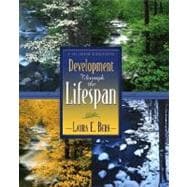
Development Through the Lifespan

ISBN: 9780205391578 | 0205391575
Edition: 3rd
Format: Hardcover
Publisher: Allyn & Bacon
Pub. Date: 1/1/2004

Why Rent from Knetbooks?

Because Knetbooks knows college students. Our rental program is designed to save you time and money. Whether you need a textbook for a semester, quarter or even a summer session, we have an option for you. Simply select a rental period, enter your information and your book will be on its way!

Top 5 reasons to order all your textbooks from Knetbooks:

  • We have the lowest prices on thousands of popular textbooks
  • Free shipping both ways on ALL orders
  • Most orders ship within 48 hours
  • Need your book longer than expected? Extending your rental is simple
  • Our customer support team is always here to help
SummaryTable of Contents
Development Through the Lifespan continues to lead the market with its currency, clarity, solid research, and rich examples of human development. Laura Berk, renowned professor and researcher in the field of human development, has revised the text with new pedagogy, a heightened emphasis on the interplay between biology and environment, and expanded coverage of biology, culture, and social issues, while emphasizing the lifespan perspective of development. Students are provided with an especially clear and coherent understanding of the sequence ... MORE

Each chapter contains in-text glossary, “Chapter Outline,” “Summary,” “Important Terms and Concepts,” and “FYI—For Further Information and Help.”

1. History, Theory, and Research Strategies.
Human Development as an Interdisciplinary, Scientific, and Applied Field Basic Issues.
The Lifespan Perspective: A Balanced Point of View.
Historical Foundations.
Mid-Twentieth-Century Theories.
Recent Theoretical Perspectives.
Comparing and Evalua... MORE

2. Biological and Environmental Foundations.
Genetic Foundations.
Reproductive Choices.
Environmental Contexts for Development.
Understanding the Relationship between Heredity and Environment.

3. Prenatal Development, Birth, and the Newborn Baby.
Prenatal Development.
Prenatal Environmental Influences.
Childbirth.
Approaches to Childbirth.
Medical Interventions.
Preterm and Low-Birth-Weight Infants.
Understanding Birth Complications.
The Newborn Baby's Capacities.
Adjusting to the New Family Unit.

4. Physical Development in Infancy and Toddlerhood.
Body Growth.
Brain Development.
Influences on Early Physical Growth.
Learning Capacities.
Motor Development.
Perceptual Development.

5. Cognitive Development in Infancy and Toddlerhood.
Piaget's Cognitive-Developmental Theory.
Information Processing.
The Social Context of Early Cognitive Development.
Individual Differences in Early Mental Development.
Language Development.

6. Emotional and Social Development in Infancy and Toddlerhood.
Erikson's Theory of Infant and Toddler Personality.
Emotional Development.
Temperament and Development.
Development of Attachment.
Self-Development during the First Years.

7. Physical and Cognitive Development in Early Childhood.
PHYSICAL DEVELOPMENT.
Body Growth.
Brain Development.
Influences on Physical Growth and Health.
Motor Development.
COGNITIVE DEVELOPMENT.
Piaget's Theory: The Preoperational Stage.
Vygotsky's Sociocultural Theory.
Information Processing.
Individual Differences in Mental Development.
Language Development.

8. Emotional and Social Development in Early Childhood.
Erikson's Theory: Initiative versus Guilt.
Self-Understanding.
Emotional Development.
Peer Relations.
Foundations of Morality.
Gender Typing.
Child Rearing and Emotional and Social Development.

9. Physical and Cognitive Development in Middle Childhood.
PHYSICAL DEVELOPMENT.
Body Growth.
Common Health Problems.
Motor Development and Play.
COGNITIVE DEVELOPMENT.
Piaget's Theory: The Concrete Operational Stage.
Information Processing.
Individual Differences in Mental Development.
Language Development.
Learning in School.

10. Emotional and Social Development in Middle Childhood.
Erikson's Theory: Industry versus Inferiority.
Self-Understanding.
Emotional Development.
Understanding Others: Perspective Taking.
Moral Development.
Peer Relations.
Gender Typing.
Family Influences.
Some Common Problems of Development.

11. Physical and Cognitive Development in Adolescence.
PHYSICAL DEVELOPMENT.
Conceptions of Adolescence.
Puberty: The Physical Transition to Adulthood.
The Psychological Impact of Pubertal Events.
Health Issues.
COGNITIVE DEVELOPMENT.
Piaget's Theory: The Formal Operational Stage.
An Information-Processing View of Adolescent Cognitive Development.
Consequences of Abstract Thought.
Sex Differences in Mental Abilities.
Learning in School.

12. Emotional and Social Development in Adolescence.
Erikson's Theory: Identity versus Identity Diffusion.
Self-Understanding.
Moral Development.
Gender Typing.
The Family.
Peer Relations.
Problems of Development.

13. Physical and Cognitive Development in Early Adulthood.
PHYSICAL DEVELOPMENT.
Biological Aging Begins in Early Adulthood.
Physical Changes.
Health and Fitness.
COGNITIVE DEVELOPMENT.
Changes in the Structure of Thought.
Information Processing: Expertise and Creativity.
Changes in Mental Abilities.
The College Experience.
Vocational Choice.

14. Emotional and Social Development in Early Adulthood.
Erikson's Theory: Intimacy versus Isolation.
Other Theories of Adult Psychosocial Development.
Close Relationships.
The Family Life Cycle.
The Diversity of Adult Lifestyles.
Career Development.

15. Physical and Cognitive Development in Middle Adulthood.
PHYSICAL DEVELOPMENT.
Physical Changes.
Health and Fitness.
Adapting to the Physical Challenges of Midlife.
COGNITIVE DEVELOPMENT.
Changes in Mental Abilities.
Information Processing.
Vocational Life and Cognitive Development.
Adult Learners: Becoming a College Student in Midlife.

16. Emotional and Social Development in Middle Adulthood.
Erikson's Theory: Generativity versus Stagnation.
Other Theories of Psychosocial Development in Midlife.
Stability and Change in Self-Concept and Personality.
Relationships at Midlife.
Vocational Life.

17. Physical and Cognitive Development in Late Adulthood.
PHYSICAL DEVELOPMENT.
Longevity.
Physical Changes.
Health, Fitness, and Disability.
COGNITIVE DEVELOPMENT.
Memory.
Language Processing.
Problem Solving.
Wisdom.
Factors Related to Cognitive Change.
Cognitive Interventions.
Lifelong Learning.

18. Emotional and Social Development in Late Adulthood.
Erikson's Theory: Ego Integrity versus Despair.
Other Theories of Psychosocial Development in Late Adulthood.
Stability and Change in Self-Concept and Personality.
Individual Differences in Psychological Well-Being.
A Changing Social World.
Relationships in Late Adulthood.
Retirement and Leisure.
Successful Aging.

19. Death, Dying and Bereavement.
How We Die.
Understanding of and Attitudes toward Death.
Thinking and Emotions of Dying People.
A Place to Die.
The Right to Die.
Bereavement: Coping with Death of a Loved One.
Death Education.

Related Products


  • Development Through the Lifespan
    Development Through the Lifespan
  • Outlines & Highlights for Development Through the Lifespan (5th Edition)
    Outlines & Highlights for Deve...
  • MyDevelopmentLab CourseCompass with Pearson eText -- Standalone Access Card -- for Development Through the Lifespan
    MyDevelopmentLab CourseCompass...
  • MyDevelopmentLab with E-Book Student Access Code Card for Development Through the Lifespan (standalone)
    MyDevelopmentLab with E-Book S...
  • Development Through the Lifespan
    Development Through the Lifespan
  • Development Through Lifespan With Internet Access Pin
    Development Through Lifespan W...
  • Development Through the Lifespan
    Development Through the Lifespan
  • Development Through the Lifespan (Cram 101)
    Development Through the Lifesp...
  • Development Through the Lifespan
    Development Through the Lifespan
  • Study Guide with Practice Tests for Development Through the Lifespan
    Study Guide with Practice Test...


Please wait while this item is added to your cart...