FREE SHIPPING BOTH WAYS
ON EVERY ORDER!
LIST PRICE:
$175.80

OUR PRICE:
$69.62

You may extend rentals at any time.


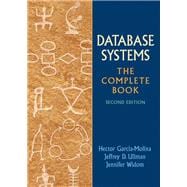
Database Systems : The Complete Book

ISBN: 9780131873254 | 0131873253
Edition: 2nd
Format: Hardcover
Publisher: Prentice Hall
Pub. Date: 6/5/2008

Why Rent from Knetbooks?

Because Knetbooks knows college students. Our rental program is designed to save you time and money. Whether you need a textbook for a semester, quarter or even a summer session, we have an option for you. Simply select a rental period, enter your information and your book will be on its way!

Top 5 reasons to order all your textbooks from Knetbooks:

  • We have the lowest prices on thousands of popular textbooks
  • Free shipping both ways on ALL orders
  • Most orders ship within 48 hours
  • Need your book longer than expected? Extending your rental is simple
  • Our customer support team is always here to help
SummaryTable of ContentsAuthor Biography
For Database Systems and Database Design and Application courses offered at the junior, senior and graduate levels in Computer Science departments.Written by well-known computer scientists, this introduction to database systems offers a comprehensive approach, focusing on database design, database use, and implementation of database applications and database management systems.The first half of the book provides in-depth coverage of databases from the point of view of the database designer, user, and application programmer. It covers the latest... MORE
... MORE
The Worlds of Database Systems
The Evolution of Database Systems
Early Database Management Systems
Relational Database Systems
Smaller and Smaller Systems
Bigger and Bigger Systems
Information Integration1.2 Overview of a Database Management System
Data-Definition Language Commands
Overview of Query Processing
Storage and Buffer Management
Transaction Processing
The Query Processor1.3 Outline of Database-System Studies1.4 References for Chapter 1I Relational Database Modeling2 The Relational Model of Data2.1 An Overview of Data Models
What is a Data Model?
Important Data Models
The Relational Model in Brief
The Semistructured Model in Brief
Other Data Models
Comparison of Modeling Approaches2.2 Basics of the Relational Model
Attributes
Schemas
Tuples
Domains2 CONTENTS
Equivalent Representations of a Relation
Relation Instances
Keys of Relations
An Example Database Schema
Exercises for Section
De ning a Relation Schema in SQL
Relations in SQL
Data Types
Simple Table Declarations
Modifying Relation Schemas
Default Values
Declaring Keys
Exercises for Section
An Algebraic Query Language
Why Do We Need a Special Query Language?
What is an Algebra?
Overview of Relational Algebra
Set Operations on Relations
Projection
Selection
Cartesian Product
Natural Joins
Theta-Joins
Combining Operations to Form Queries
Naming and Renaming
Relationships Among Operations
A Linear Notation for Algebraic Expressions
Exercises for Section
Constraints on Relations
Relational Algebra as a Constraint Language
Referential Integrity Constraints
Key Constraints
Additional Constraint Examples
Exercises for Section
Summary of Chapter 22.7 References for Chapter
Design Theory for Relational Databases3.1 Functional Dependencies
De nition of Functional Dependency
Keys of Relations
Superkeys
Exercises for Section
Rules About Functional Dependencies
Reasoning About Functional Dependencies
The Splitting/Combining Rule
Trivial Functional Dependencies
Computing the Closure of Attributes
Why the Closure Algorithm Works
The Transitive Rule
Closing Sets of Functional Dependencies
Projecting Functional Dependencies
Exercises for Section
Design of Relational Database Schemas
Anomalies
Decomposing Relations
Boyce-Codd Normal Form
Decomposition into BCNF
Exercises for Section
Decomposition: The Good, Bad, and Ugly
Recovering Information from a Decomposition
The Chase Test for Lossless Join
Why the Chase Works
Dependency Preservation
Exercises for Section
Third Normal Form
Definition of Third Normal Form
The Synthesis Algorithm for 3NF Schemas
Why the 3NF Synthesis Algorithm Works
Exercises for Section
Multivalued Dependencies
Attribute Independence and Its ConsequentRedundancy
Definition of Multivalued Dependencies
Reas
Table of Contents provided by Publisher. All Rights Reserved.

Hector Garcia-Molina is the L. Bosack and S. Lerner Professor of Computer Science and Electrical Engineering at Stanford University. His research interests include digital libraries, information integration, and database applications on the Internet. He was a recipient of the SIGMOD Innovations Award and a member of PITAC (President's Information-Technology Advisory Council). He currently serves on the Board of Directors of Oracle Corp.


Jeffrey D. Ullman is the Stanford W. Ascherman Professor of Computer Science (emeritus) at Stanford University. He is the author or co-author of 16 books, including Elements of ML Programming (Prentice Hall 1998). His research interests include data mining, information integration, and electronic education. He is a member of the National Academy of Engineering, and recipient of a Guggenheim Fellowship, the Karl V. Karlstom Outstanding Educator Award, the SIGMOD Contributions and Edgar F. Codd Innovations Awards, and the Knuth Prize.


Jennifer Widom is Professor of Computer Science and Electrical Engineering at Stanford University. Her research interests span many aspects of nontraditional data management. She is an ACM Fellow and a member of the National Academy of Engineering, she received the ACM SIGMOD Edgar F. Codd Innovations award in 2007 and was a Guggenheim Fellow in 2000, and she has served on a variety of program committees, advisory boards, and editorial boards.

Related Products


  • Database Systems : The Complete Book
    Database Systems : The Complet...
  • Outlines and Highlights for Database Systems by Hector Garcia-Molina, Jennifer Widom, Jeffrey D Ullman, Isbn : 9780131873254
    Outlines and Highlights for Da...


Please wait while this item is added to your cart...