FREE SHIPPING BOTH WAYS
ON EVERY ORDER!
LIST PRICE:
$19.95

Sorry, this item is currently unavailable.

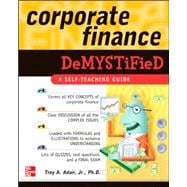
Corporate Finance Demystified

ISBN: 9780071459105 | 0071459103
Edition: 1st
Format: Paperback
Publisher: McGraw-Hill
Pub. Date: 12/15/2005

Why Rent from Knetbooks?

Because Knetbooks knows college students. Our rental program is designed to save you time and money. Whether you need a textbook for a semester, quarter or even a summer session, we have an option for you. Simply select a rental period, enter your information and your book will be on its way!

Top 5 reasons to order all your textbooks from Knetbooks:

  • We have the lowest prices on thousands of popular textbooks
  • Free shipping both ways on ALL orders
  • Most orders ship within 48 hours
  • Need your book longer than expected? Extending your rental is simple
  • Our customer support team is always here to help
SummaryTable of ContentsAuthor Biography
There' s no easier, faster, or more practical way to learn the really tough subjects "Corporate Finance Demystified" offers a comprehensive introduction to corporate finance principles, the time value of money, including present value, amortization schedules, and more. This self-teaching guide comes complete with key points, background information, quizzes at the end of each chapter, and even a final exam. Simple enough for beginners but challenging enough for advanced students, this is a lively and entertaining brush-up, introductory text, or ... MORE
... MORE
Acknowledgmentsxi
Introductionxii
PART ONE INTRODUCTION
What Is Corporate Finance?
3(12)
What Is Finance?
4(2)
The Subfields of Finance
6(2)
The Parts of Corporate Finance
8(2)
So, Why Is This So Complicated?
10(1)
Why Are We Studying Corporate Finance?
10(1)
Quiz
11(4)
Setting the Stage
15(8)
Basic Forms of Business Organization
15(2)
Goal of the Financial Manager
17(1)
Agency Relationships and Conflicts
17(2)
Quiz
19(4)
Accounting Statements and Cash Flows
23(10)
The Balance Sheet: Assets vs. Liabilities
23(2)
The Balance Sheet: Short-Term vs. Long-Term Accounts
25(1)
The Income Statement
26(1)
Taxes
27(1)
Cash Flow From Assets
28(1)
Quiz
29(4)
Common-Size, Common-Base Year, and Ratio Analysis
33(20)
The General Goal of Ratio Analysis: Summarization
34(1)
``Good'' and ``Bad'' Values for Ratios
35(1)
An Additional Effect of Ratio Analysis: Standardization
36(1)
Common-Size Statement Analysis
36(3)
Common-Base Year Analysis
39(1)
Liquidity Ratios
40(3)
Leverage Ratios
43(2)
Asset Utilization Ratios
45(1)
Profitability Ratios
46(1)
Quiz
47(6)
PART TWO ``I WILL GLADLY PAY YOU $2 TOMORROW FOR $1 TODAY'': THE TIME VALUE OF MONEY
Present and Future Value
53(18)
Using a Financial Calculator or a Spreadsheet Program
54(1)
Time Lines
55(2)
The TVM Formulas
57(3)
Calculator Setup and Notational Conventions
60(1)
Using the TVM Formulas
61(1)
Example---Car Loan with Delayed First Payment
62(2)
Example---Retirement Calculation
64(2)
What About Annuities Due?
66(2)
Quiz
68(3)
Compounding and Interest Rate Conversion: When What You've Got Isn't What You Need
71(12)
Interest Rate Flavors
72(1)
APRs Explained
73(2)
Just Because You Have a New Toy Doesn't Mean You Have To Use It!
75(1)
Dealing with Other Nominal Rates
76(1)
A Caution on Using Calculators or Textbook Formulas to Convert Rates
77(2)
Quiz
79(4)
Payment Composition and Amortization Schedules
83(12)
Calculating Payment Components for Pure Discount Loans
84(1)
Calculating Payment Components for Interest-Only Loans
85(1)
Amortized Loans: Constant-Payment Loans
86(1)
Amortized Loans: Constant-Principal Loans
87(2)
A Final Note on Amortized Loans
89(1)
Quiz
90(5)
PART THREE VALUATION
Valuing Bonds
95(12)
The Conventions of Bond Quotations
95(2)
The Mathematics of a Bond
97(1)
There are Rates, and then there are Rates that aren't Really Rates
97(3)
Solving for Bond Price
100(1)
Solving for Anything but Bond Price
101(1)
The Parts of YTM
102(2)
Quiz
104(3)
Valuing Stocks
107(14)
The Conventions of Stock Quotations
108(1)
The Mathematics of a Stock: Constant Dividends
108(2)
The Mathematics of a Stock: Constantly Growing Dividends
110(3)
The Mathematics of a Stock: Constantly Shrinking Dividends
113(1)
What g > r Really Means
113(1)
The Mathematics of a Stock: Nonconstant Dividends
114(3)
Dividend Yield and Expected Capital Gains Yields on Stocks
117(1)
Quiz
118(3)
Valuing Projects: The Capital-Budgeting Decision Rules
121(24)
Why Cash Flow Signs Matter Now
122(1)
Notational Conventions, Part 2
123(2)
Net Present Value
125(1)
The Intuition behind NPV
126(1)
Payback
127(2)
Discounted Payback
129(2)
A Comparison of the Intuitions in Payback and Discounted Payback
131(1)
Average Accounting Return (AAR)
131(1)
Internal Rate of Return (IRR)
132(1)
The Intuition behind IRR
133(1)
Problems with IRR
133(4)
Modified IRR (MIRR)
137(1)
Profitability Index (PI)
138(1)
Repeated Projects: Equivalent Annual Cost
139(1)
Quiz
140(5)
PART FOUR WHERE DO INTEREST RATES COME FROM? RISK, RETURN, AND THE COST OF CAPITAL
Measuring Risk and Return
145(12)
Using the Past to Predict the Future: Computing the Average and Standard Deviation of Historic Returns
146(3)
Explicit Guessing: Calculating the Expected Return and Standard Deviation across Expected States of Nature
149(2)
Choosing Which Method to Use for Average and Standard Deviation
151(1)
Portfolio Averages and Standard Deviations
151(2)
Quiz
153(4)
Calculating Beta
157(8)
Beta Estimation Methodology
158(1)
Choosing and Gathering the Necessary Data
159(1)
Calculating the Beta
160(1)
Portfolio Betas
161(1)
Quiz
161(4)
Analyzing the Security Market Line
165(8)
The Relationship between the Security Market Line and the CAPM Equation
166(1)
Estimating the Intercept of the SML
166(1)
Estimating the Slope of the SML
167(1)
Estimating the X Variable, Beta
168(1)
Bringing it All Together
169(1)
Quiz
169(4)
The Weighted Average Cost of Capital
173(10)
The WACC Formula
174(1)
Calculating the Component Cost of Equity, RE
175(1)
Calculating the Component Cost of Preferred Stock, Rp
176(1)
Calculating the Before-Tax Cost of Debt, RD
176(1)
Calculating the WACC
177(1)
A Note on Nominal vs. Effective Rates
177(1)
Quiz
177(6)
PART FIVE ADVANCED TOPICS IN CORPORATE FINANCE
Estimating Future Cash Flows
183(14)
Sample Project
184(1)
Calculating Total Cash Flow: The Formula
184(1)
Guiding Principles for Calculating Total Cash Flow
185(1)
Calculating Depreciation
186(1)
Operating Cash Flow (OCF)
187(1)
Net Capital Spending
188(1)
Changes in NWC
189(2)
Bringing it All Together: Total Cash Flow
191(1)
Quiz
191(6)
Scenario Analysis and Sensitivity Analysis
197(12)
Sample Project
198(1)
Scenario Analysis
199(3)
Sensitivity Analysis
202(4)
When to Use Which
206(1)
Quiz
206(3)
Option Valuation
209(20)
Options: The Basics
210(1)
Values of Options at Expiration
211(6)
Valuing a Call Option before Expiration: The Binomial Option Pricing Model
217(5)
Valuing a Call Option before Expiration: The Black-Scholes Option Pricing Model
222(2)
Put-Call Parity
224(1)
Quiz
224(5)
Appendix A Depreciation Charts229(4)
Appendix B Values for the Standard Normal Cumulative Distribution Function233(4)
Final Exam237(26)
Answers to Quiz and Exam Questions263(6)
Index269
Troy A. Adair, Jr., Ph.D. (Ann Arbor, MI) is the coordinator and primary instructor for corporate finance at the University of Michigan. He is the author of Excel Applications to Accompany Corporate Finance with Excel Tutor.

Related Products


  • Corporate Finance Demystified 2/E
    Corporate Finance Demystified ...


Please wait while this item is added to your cart...