FREE SHIPPING BOTH WAYS
ON EVERY ORDER!
LIST PRICE:
$71.40

Sorry, this item is currently unavailable.

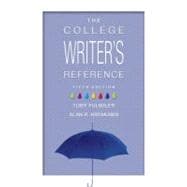
The College Writer's Reference (Tabbed Version)
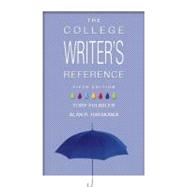
ISBN: 9780131584624 | 0131584626
Format: Paperback
Publisher: Prentice Hall
Pub. Date: 1/1/2008

Why Rent from Knetbooks?

Because Knetbooks knows college students. Our rental program is designed to save you time and money. Whether you need a textbook for a semester, quarter or even a summer session, we have an option for you. Simply select a rental period, enter your information and your book will be on its way!

Top 5 reasons to order all your textbooks from Knetbooks:

  • We have the lowest prices on thousands of popular textbooks
  • Free shipping both ways on ALL orders
  • Most orders ship within 48 hours
  • Need your book longer than expected? Extending your rental is simple
  • Our customer support team is always here to help
SummaryTable of Contents
This brief handbook offers the most focus on the writing process. The entire book is also available on the Internet, where it is fully searchable and customizable. This writing handbook focuses on the writing process, the research process, document design, clarity, punctuation, grammar, and documentation. This is a perfect reference for anyone wanting to produce effective written communications.
... MORE
Box Listsp. v
Prefacep. vii
Reading and Writing in Collegep. 1
Why Writing Mattersp. 3
What is the purpose!
Who is the audience?
What is the situation?
What is your writing voice?
The Writing Processp. 8
Planning
Composing
Researching
Revising
Editing
If English is your second language
Keeping a Journalp. 12
Journals in the writing class
Journals across the curriculum
Journals for personal expression
Strategies for Startingp. 17
Brainstorm to find ideas
Freewrite to advance ideas
Cluster to connect ideas
Outline to organize ideas
Question to test ideas
Reading and Writing with Imagesp. 22
The elements of composition
Words
Color
Composing College Papersp. 31
Reflecting on Experiencep. 33
Character (who)
Subject (what)
Setting (where)
Seguence (when)
Theme (why)
Perspective (how)
Shaping the whole paper
Explaining Conceptsp. 45
Writing to explain
Finding a topic
Developing a thesis
Using strategies to explain
Organizing with logic
Maintaining a neutral perspective
Shaping the whole paper
Arguing Positionsp. 62
Selecting an issue
Analyzing an issue
Developing an argument
Organizing the paper
Shaping the whole paper
Writing About Literaturep. 76
Presenting a text
Exploring a text
Finding a topic
Developing an interpretation
Shaping the whole paper
Using secondary sources
The Revising Processp. 84
General revising strategies
Focused revising strategies
The Research Processp. 91
Beginning the Research Processp. 93
Keeping a research log
Finding a topic
Developing a research question
Formulating a working thesis
Using the writing process
Conducting Library Researchp. 99
Planning library research
Finding sources of information
Taking notes
Conducting Internet Researchp. 106
Search engines
Limiting your search
Search strategies
E-mail, lists, and newsgroups
Conducting Field Researchp. 112
Observing places
Interviewing people
Conducting surveys
Evaluating Research Sourcesp. 116
Evaluating library sources
Evaluating Internet sources
Evaluating field sources
Using Research Sourcesp. 125
Organizing sources
Integrating information
Paraphrasing
Summarizing
Identifying Internet sources in signal phrases
Incorporating visual images
Avoiding Plagiarismp. 136
What plagiarism is
What plagiarism is not
Recognizing and avoiding plagiarism
Writing in the Disciplines (MLA, APA, CMS)p. 143
Understanding Differences Among the Disciplinesp. 145
Differences among disciplines
Similarities among disciplines
MLA: Writing in Languages and Literaturep. 150
Aims
Style
Guidelines for formatting manuscripts
Guidelines for in-text citations
Conventions for the list of Works Cited
Documenting books
Documenting periodicals
Documenting electronic sources
Documenting other sources
Student paper: MLA style
APA: Writing in the Social Sciencesp. 191
Aims
Style
Guidelines for formatting manuscripts
Guidelines for in-text citations
Guidelines for the APA References page
Documenting books
Documenting periodicals
Documenting online sources
Documenting other sources
Informal research paper: APA style
CMS: Writing in the Arts and Humanitiesp. 224
Aims
Style
Guidelines for formatting manuscripts
Guidelines for CMS documentation
Documenting books: First reference
Documenting periodicals: First reference
Writing in the Physical and Biological Sciencesp. 240
Aims
Style
Number systems: Documenting sources
Writing in Businessp. 246
Aims
Style
Common forms of writing in business
Presenting and Publishingp. 257
Designing Printed Documentsp. 259
Objectives of design
Layout
Typography
Graphics
Illustrations
Writing for the Internetp. 264
Writing for the Web
E-mail and newsgroups
Weblogs
Writing for the Worldp. 271
Reports
Pamphlets and brochures
Newsletters
Press releases
Advocacy
Portfolios and Class Booksp. 279
Writing portfolios
Course portfolios
Story portfolios
Class books
Oral Presentationsp. 285
Interpreting the assignment
Preparing a speaking text
Speaking in public
Creative options
Editing: Clarityp. 291
The Editing Processp. 293
Paragraph Structurep. 294
Unity
Internal organization
Coherence
Strong Openingsp. 301
Opening strategies
Sharper openings
Thoughtful Closingsp. 305
Rhetorical questions
Genuine questions
Concise summary
Call to action
Implications
Concise Languagep. 308
Generalities
Idle words
Redundancy
Pretentious language
Euphemisms
Vital Sentencesp. 312
Specific subjects
Concrete terms
Action verbs
Changing nouns back to verbs
Active voice
The Right Wordp. 316
Dictionaries, thesauruses, and usage guides
Roots, prefixes, and suffixes
Denotations and connotations
Idiomatic expressions
Slang, regionalisms, and colloquialisms
Jargon
Figurative language
Cliches
Unbiased Languagep. 325
Stereotypes
Group labels
Gender-neutral language
Proofreadingp. 330
Editing: Grammarp. 333
Sentence Patternsp. 335
Types of sentences
Relationships between equal ideas (coordination)
Hierarchy of ideas (subordination)
Parallel structures
Sentence Fragmentsp. 344
Missing verbs or subjects
Dependent clause fragments
Intentional fragments
Comma Splices and Run-On Sentencesp. 346
Using a comma and a coordinating conjunction
Adding a semicolon
Adding a colon
Writing separate sentences
Using subordination
Creating one independent clause
Shifts and Mixed Constructionsp. 350
In person and number
In tense
In mood
In voice and subject
Between direct and indirect quotation
Mixed constructions
Illogical constructions
Faulty predication
Verbsp. 355
Standard verb forms
Irregular verb forms
Sit and set, lie and lay
Auxiliary verbs
Tense
Mood
Voice
Subject-Verb Agreementp. 368
In person and number
Interruptions between subject and verb
Subject following the verb
With linking verbs
With subjects joined by and
With subjects joined by or and nor
With collective nouns
With indefinite pronouns
With who, which, and that
With nouns ending in -s, nouns that specify amounts, and titles
Pronounsp. 377
Reference
Pronoun-antecedent agreement
Case
Adjectives and Adverbsp. 387
Adjective or adverb?
After verbs
Commonly confused modifiers
Comparatives and superlatives
Avoiding double negatives
Modifier Placementp. 392
Misplaced
Squinting
Dangling
Disruptive
Grammar Termsp. 395
Elements of a sentence
Parts of speech
Classifying sentences
Editing: Punctuationp. 415
Commasp. 417
To connect independent clauses
After introductory elements
To set off nonessential information
To set off parenthetical elements
Between items in a series
Between equal modifiers
To set off contrast elements, tag sentences, and direct address
With quotations
With numbers, dates, names, and places
To prevent misreading
Semicolonsp. 425
Between clauses
With transitional expressions to join two independent clauses
Between items in a series containing commas
Colonsp. 426
As marks of introduction
In time references, biblical citations, titles, and business communication
End Punctuationp. 429
Periods
Question marks
Exclamation points
Apostrophesp. 432
To show possession
In plurals of words used as words, letters, numbers, and symbols
To form contractions
Quotation Marksp. 435
For direct quotations
For dialogue
For certain titles
For special purposes
With other punctuation
Parentheses and Bracketsp. 441
Parentheses
Brackets
Dashes, Slashes, and Ellipsis Pointsp. 444
Dashes
Ellipsis points
Slashes
Editing: Conventions of Written Englishp. 447
Spellingp. 449
Commonly confused words
Spelling rules
Capitalizationp. 457
First word of a sentence
Quotations and lines of poetry
Proper nouns
Titles
Capitalization and punctuation
Hyphensp. 462
At the ends of lines
After some prefixes
In compound words
Numbers, fractions, and units of measure
Numbersp. 464
Figures or spelled-out numbers?
Conventional uses of numbers
Abbreviationsp. 466
Titles and degrees
With numbers
Degrees, numbers, and units of measure
Symbols
Geographic names
Common Latin abbreviations
Acronyms and initials
Italics and Underliningp. 470
For titles of major works
For individual trains, ships, and planes
For foreign words
For words as words and for letters as symbols
For emphasis
Glossary/Indexesp. 473
Glossary of Usagep. 475
ESL Index
Index
Credits
WAC Box List
Editing Symbols
Table of Contents provided by Ingram. All Rights Reserved.

Related Products


  • College Reference with E-Book 2003 MLA Update
    College Reference with E-Book ...
  • College Writer's Reference and Student OneKey
    College Writer's Reference and...
  • College Writer's Reference with APA Updates and Companion Website Subscription
    College Writer's Reference wit...
  • College Writer's Reference, The (no tabs), (with MyCompLab NEW with E-Book Student Access Code Card)
    College Writer's Reference, Th...
  • College Writer's Reference, The (Tabbed Version) (with MyCompLab NEW with E-Book Student Access Code Card)
    College Writer's Reference, Th...
  • MyCompLab NEW with Pearson eText Student Access Code Card for The College Writer's Reference (Tabbed Version) (standalone)
    MyCompLab NEW with Pearson eTe...
  • MyCompLab with Pearson eText -- Standalone Access Card -- for College Writer's Reference
    MyCompLab with Pearson eText -...
  • Supplement: College Writer's Reference, The, with 2001 APA Guidelines - College Writer's Reference w
    Supplement: College Writer's R...
  • The College Writer's Reference
    The College Writer's Reference
  • The College Writer's Reference (No Tabs)
    The College Writer's Reference...


Please wait while this item is added to your cart...