FREE SHIPPING BOTH WAYS
ON EVERY ORDER!
LIST PRICE:
$74.99

OUR PRICE:
$59.39

You may extend rentals at any time.


CMMI for Development : Guidelines for Process Integration and Product Improvement
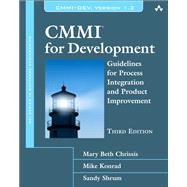
ISBN: 9780321711502 | 0321711505
Edition: 3rd
Format: Hardcover
Publisher: Addison-Wesley Professional
Pub. Date: 1/1/2011

Why Rent from Knetbooks?

Because Knetbooks knows college students. Our rental program is designed to save you time and money. Whether you need a textbook for a semester, quarter or even a summer session, we have an option for you. Simply select a rental period, enter your information and your book will be on its way!

Top 5 reasons to order all your textbooks from Knetbooks:

  • We have the lowest prices on thousands of popular textbooks
  • Free shipping both ways on ALL orders
  • Most orders ship within 48 hours
  • Need your book longer than expected? Extending your rental is simple
  • Our customer support team is always here to help
SummaryTable of ContentsAuthor Biography
CMMI#xAE; for Development (CMMI-DEV) describes best practices for the development and maintenance of products and services across their entire lifecycle. By integrating essential bodies of knowledge, CMMI-DEV provides a single, comprehensive framework for organizations to assess their development and maintenance processes, implement improvements, and measure progress. #xA0; Already widely adopted throughout the world for disciplined, high-quality engineering, CMMI-DEV version 1.3 now accommodates other modern approaches as well, including the u... MORE

List of Perspectives xiii

Preface xv

Book Acknowledgments xxi


Part One: About CMMI for Development 1


Chapter 1: Introduction 3

About Process Improvement 4

About Capability Maturity Models 9

Evolution of CMMI 10

... MORE

CMMI for Development 18


Chapter 2: Process Area Components 19

Core Process Areas and CMMI Models 19

Required, Expected, and Informative Components 19

Components Associated with Part Two 20

Supporting Informative Components 25

Numbering Scheme 26

Typographical Conventions 27


Chapter 3: Tying It All Together 31

Understanding Levels 31

Structures of the Continuous and Staged Representations 32

Understanding Capability Levels 34

Understanding Maturity Levels 41

Process Areas 46

Equivalent Staging 49

Achieving High Maturity 52


Chapter 4: Relationships Among Process Areas 59

Process Management 60

Project Management 64

Engineering 68

Recursion and Iteration of Engineering Processes 74

Support 77


Chapter 5: Using CMMI Models 85

Adopting CMMI 90

Your Process Improvement Program 94

Selections that Influence Your Program 98

CMMI Models 99

Interpreting CMMI When Using Agile Approaches 100

Using CMMI Appraisals 104

Appraisal Requirements for CMMI 105

SCAMPI Appraisal Methods 105

Appraisal Considerations 106

CMMI Related Training 107


Chapter 6: Essays and Case Studies 113

Case Studies 113

Essays 137


Part Two: Generic Goals and Generic Practices, and the Process Areas 163

Generic Goals and Generic Practices 165

Causal Analysis and Resolution 233

Configuration Management 243

Decision Analysis and Resolution 257

Integrated Project Management 267

Measurement and Analysis 287

Organizational Process Definition 303

Organizational Process Focus 317

Organizational Performance Management 331

Organizational Process Performance 351

Organizational Training 365

Product Integration 377

Project Monitoring and Control 393

Project Planning 403

Process and Product Quality Assurance 425

Quantitative Project Management 433

Requirements Development 455

Requirements Management 473

Risk Management 481

Supplier Agreement Management 497

Technical Solution 509

Validation 531

Verification 541


Part Three: The Appendices 553

Appendix A: References 555

Appendix B: Acronyms 561

Appendix C: CMMI Version 1.3 Project Participants 565

Appendix D: Glossary 573


Book Contributors 605


Index 623

Mary Beth Chrissis is a senior member of the technical staff at the Software Engineering Institute (SEI). Since joining the SEI in 1988, Chrissis has been a coauthor of the Capability Maturity Model Integration for Development (CMMI-DEV) and Capability Maturity Model for Software (SW-CMM) models. Currently, Chrissis chairs the CMMI Configuration Control Board (CCB), is a member of the IEEE Software and Systems Engineering Standards Executive Committee, and is an instructor of various CMMI model-related courses at the SEI. Prior to joining the SEI, Chrissis worked at GTE Government Systems in Rockville, Maryland; Dravo Automation Sciences in Pittsburgh, Pennsylvania; and Sperry Corporation in Great Neck, New York. Before coming to the SEI, Chrissis was pursuing her M.S. in computer science from Johns Hopkins University, and in 1983 she received a B.S. from Carnegie Mellon University.


Mike Konrad is a senior member of the technical staff and has been at the Software Engineering Institute (SEI) at Carnegie Mellon University since 1988. Dr. Konrad is the Chief Architect of CMMI and Manager of SEI’s CMMI Modeling Team. Previously, he was Chair of the CMMI Configuration Control Board (2001-2006) and a member of the International Process Research Consortium (2004-2006). Also, he was a member of the teams that developed the original Software CMM Version 1.0 (1988-1991) and ISO 15504 (1993-1997). Prior to joining the SEI, Konrad worked with several companies in computer science-related positions, including ISSI, SAIC, and Honeywell and briefly with George Mason University and the University of Maryland. He obtained his Ph.D. in mathematics in 1978 from Ohio University, Athens, Ohio.


Sandy Shrum is a senior writer/editor and communications point of contact for the Software Engineering Process Management program at the Software Engineering Institute (SEI). Besides this book, she has coauthored two other CMMI books: CMMI®-ACQ: Guidelines for Improving the Acquisition of Products and Services (Addison-Wesley, 2009) and CMM® for Services: Guidelines for Superior Service, Second Edition (Addison-Wesley, 2007). She has been with the SEI since 1995 and has been a member of the CMMI Development Team since the CMMI project’s inception in 1998. Her roles on the project have included model author, small review team member, reviewer, editor, model development process coordinator, and quality assurance process owner. Before joining the SEI, Sandy worked for eight years with Legent Corporation, a Virginia-based software company. Her experience as a technical communicator dates back to 1988, when she earned her M.S. in professional writing from Carnegie Mellon University. Her undergraduate degree, a B.S. in business administration, was earned at Gannon University, Erie, Pennsylvania.

Related Products


  • CMMI : Guidelines for Process Integration and Product Improvement
    CMMI : Guidelines for Process ...
  • CMMI for Development : Guidelines for Process Integration and Product Improvement
    CMMI for Development : Guideli...


Please wait while this item is added to your cart...