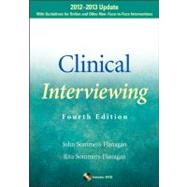
Because Knetbooks knows college students. Our rental program is designed to save you time and money. Whether you need a textbook for a semester, quarter or even a summer session, we have an option for you. Simply select a rental period, enter your information and your book will be on its way!
| Preface | p. xi |
| Becoming a Mental Health Professional | p. 1 |
| Introduction: Philosophy and Organization | p. 3 |
| Welcome to the Journey | p. 4 |
| Theoretical Orientations | p. 7 |
| Basic Requirements for Clinical Interviewers | p. 9 |
| Goals and Objectives of This Book | p. 14 |
| Summary | p. 15 |
| Suggested Readings and Resources | p. 15 |
| Found... MORE | p. 17 |
| Defining Clinical Interviewing | p. 18 |
| Self-Awareness | p. 24 |
| The Physical Setting | p. 31 |
| Professional and Ethical Issues | p. 37 |
| Summary | p. 48 |
| Suggested Readings and Resources | p. 48 |
| Listening and Relationship Development | p. 51 |
| Basic Attending, Listening, and Action Skills | p. 53 |
| Attending Behavior | p. 54 |
| Moving Beyond Attending | p. 60 |
| Nondirective Listening Responses | p. 62 |
| The Pull to Reassurance | p. 72 |
| Directive Listening Responses | p. 73 |
| Summary | p. 80 |
| Suggested Readings and Resources | p. 81 |
| Directives: Questions and Action Skills | p. 83 |
| Using Questions | p. 84 |
| Directive Action Responses | p. 97 |
| Summary | p. 111 |
| Suggested Readings and Resources | p. 111 |
| Theoretically Supported and Evidence-Based Relationships in Clinical Interviewing | p. 113 |
| Carl Rogers's Core Conditions | p. 114 |
| Evidence-Based Psychoanalytic and Interpersonal Relationship Concepts | p. 124 |
| Evidence-Based Behavioral and Social Psychology Concepts | p. 132 |
| Evidence-Based Feminist Relationship Concepts | p. 135 |
| Evidence-Based Solution-Focused and Constructive Relationship Concepts | p. 138 |
| Summary | p. 138 |
| Suggested Readings and Resources | p. 139 |
| Structuring and Assessment | p. 141 |
| An Overview of the Interview Process | p. 143 |
| Structural Models | p. 144 |
| The Introduction | p. 145 |
| The Opening | p. 154 |
| The Body | p. 160 |
| Applying Interventions | p. 164 |
| The Closing | p. 164 |
| Termination | p. 168 |
| Summary | p. 172 |
| Suggested Readings and Resources | p. 172 |
| Intake Interviewing and Report Writing | p. 175 |
| What Is an Intake Interview? | p. 175 |
| Objectives of Intake Interviewing | p. 177 |
| Factors Affecting Intake Interview Procedures | p. 193 |
| Brief Intake Interviewing | p. 194 |
| The Intake Report | p. 197 |
| Summary | p. 211 |
| Suggested Readings and Resources | p. 212 |
| The Mental Status Examination | p. 213 |
| Objectivity | p. 214 |
| What Is a Mental Status Examination? | p. 214 |
| The Generic Mental Status Examination | p. 216 |
| When to Use Mental Status Examinations | p. 240 |
| Summary | p. 242 |
| Suggested Readings and Resources | p. 243 |
| Suicide Assessment | p. 245 |
| Personal Reactions to Suicide | p. 246 |
| Suicide Statistics | p. 246 |
| Key Components in a State-of-the-Science Suicide Assessment Interview | p. 247 |
| Suicide Risk Factors and Suicide Risk Factor Assessment | p. 247 |
| Conducting a Thorough Suicide Assessment | p. 256 |
| Suicide Intervention | p. 268 |
| Professional Issues | p. 272 |
| Summary | p. 276 |
| Suggested Readings and Resources | p. 277 |
| Diagnosis and Treatment Planning | p. 279 |
| Principles of Psychiatric Diagnosis | p. 279 |
| Diagnostic Assessment: Methods and Procedures | p. 287 |
| The Science of Clinical Interviewing: Diagnostic Reliability and Validity | p. 289 |
| A Balanced Approach to Conducting Diagnostic Clinical Interviews | p. 290 |
| Treatment Planning | p. 295 |
| An Integrated (Biopsychosocial) Approach to Treatment Planning | p. 297 |
| Summary | p. 307 |
| Suggested Readings and Resources | p. 307 |
| Interviewing Special Populations | p. 309 |
| Challenging Clients and Demanding Situations | p. 311 |
| Part One Challenging Clients | p. 311 |
| Part Two Demanding Situations | p. 331 |
| Summary | p. 338 |
| Suggested Readings and Resources | p. 339 |
| Interviewing Young Clients | p. 341 |
| Special Considerations in Working with Children | p. 342 |
| The Introduction | p. 343 |
| The Opening | p. 345 |
| The Body | p. 355 |
| The Closing | p. 365 |
| Termination | p. 367 |
| Summary | p. 368 |
| Suggested Readings and Resources | p. 368 |
| Principles and Tips for Interviewing Couples and Families | p. 371 |
| Some Ironies of Interviewing Couples and Families | p. 372 |
| Interviewing Stages and Tasks | p. 374 |
| Special Considerations | p. 390 |
| Summary | p. 399 |
| Suggested Readings and Resources | p. 399 |
| Interviewing in a Diverse and Multicultural World | p. 401 |
| Relationship in the Context of Diversity | p. 401 |
| Four Large Worldviews | p. 405 |
| Other Diverse Client Populations | p. 416 |
| Cultural Complexities and Identities | p. 423 |
| Assessment and Culture-Bound Syndromes | p. 424 |
| Professional Considerations | p. 428 |
| Summary | p. 429 |
| Suggested Readings and Resources | p. 430 |
| Interviewing in Online and Other Non-Face-to-Face Environments | p. 431 |
| Technology as an Extension of the Self | p. 432 |
| Non-FtF Assessment and Intervention Research | p. 437 |
| Ethical and Practical Problems and Solutions | p. 440 |
| Conducting Online or Non-FtF Interviews | p. 446 |
| Summary | p. 448 |
| Appendix Extended Mental Status Examination (MSE) Interview Protocol | p. 449 |
| Preparation Steps | p. 450 |
| MSE Categories | p. 451 |
| References | p. 459 |
| Author Index | p. 497 |
| Subject Index | p. 511 |
| About the DVD | p. 527 |
| Table of Contents provided by Ingram. All Rights Reserved. |