FREE SHIPPING BOTH WAYS
ON EVERY ORDER!
LIST PRICE:
$221.32

OUR PRICE:
$54.78

You may extend rentals at any time.


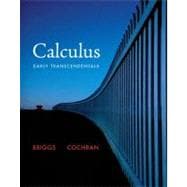
Calculus : Early Transcendentals

ISBN: 9780321570567 | 0321570561
Edition: 1st
Format: Hardcover
Publisher: Pearson
Pub. Date: 1/5/2010

Why Rent from Knetbooks?

Because Knetbooks knows college students. Our rental program is designed to save you time and money. Whether you need a textbook for a semester, quarter or even a summer session, we have an option for you. Simply select a rental period, enter your information and your book will be on its way!

Top 5 reasons to order all your textbooks from Knetbooks:

  • We have the lowest prices on thousands of popular textbooks
  • Free shipping both ways on ALL orders
  • Most orders ship within 48 hours
  • Need your book longer than expected? Extending your rental is simple
  • Our customer support team is always here to help
SummaryTable of ContentsAuthor Biography
This book is designed for a three-semester or four-quarter calculus course covering single variable and multivariable calculus for mathematics, engineering, and science majors.Drawing on their decades of teaching experience, William Briggs and Lyle Cochran have created a calculus text that carries the teacher's voice beyond the classroom. That voiceevident in the narrative, the figures, and the questions interspersed in the narrativeis a master teacher leading students to deeper levels of understanding. The authors appeal to students' geometric... MORE

1. Functions

1.1 Review of Functions

1.2 Representing Functions

1.3 Inverse, Exponential, and Logarithm Functions

1.4 Trigonometric Functions and Their Inverses


... MORE

2.1 The Idea of Limits

2.2 Definitions of Limits

2.3 Techniques for Computing Limits

2.4 Infinite Limits

2.5 Limits at Infinity

2.6 Continuity

2.7 Precise Definitions of Limits


3. Derivatives

3.1 Introducing the Derivative

3.2 Rules of Differentiation

3.3 The Product and Quotient Rules

3.4 Derivatives of Trigonometric Functions

3.5 Derivatives as Rates of Change

3.6 The Chain Rule

3.7 Implicit Differentiation

3.8 Derivatives of Logarithmic and Exponential Functions

3.9 Derivatives of Inverse Trigonometric Functions

3.10 Related Rates


4. Applications of the Derivative

4.1 Maxima and Minima

4.2 What Derivatives Tell Us

4.3 Graphing Functions

4.4 Optimization Problems

4.5 Linear Approximation and Differentials

4.6 Mean Value Theorem

4.7 L’Hôpital’s Rule

4.8 Antiderivatives


5. Integration

5.1 Approximating Areas under Curves

5.2 Definite Integrals

5.3 Fundamental Theorem of Calculus

5.4 Working with Integrals

5.5 Substitution Rule


6. Applications of Integration

6.1 Velocity and Net Change

6.2 Regions between Curves

6.3 Volume by Slicing

6.4 Volume by Shells

6.5 Length of Curves

6.6 Physical Applications

6.7 Logarithmic and exponential functions revisited

6.8 Exponential models


7. Integration Techniques

7.1 Integration by Parts

7.2 Trigonometric Integrals

7.3 Trigonometric Substitution

7.4 Partial Fractions

7.5 Other Integration Strategies

7.6 Numerical Integration

7.7 Improper Integrals

7.8 Introduction to Differential Equations


8. Sequences and Infinite Series

8.1 An Overview

8.2 Sequences

8.3 Infinite Series

8.4 The Divergence and Integral Tests

8.5 The Ratio and Comparison Tests

8.6 Alternating Series


9. Power Series

9.1 Approximating Functions with Polynomials

9.2 Power Series

9.3 Taylor Series

9.4 Working with Taylor Series


10. Parametric and Polar Curves

10.1 Parametric Equations

10.2 Polar Coordinates

10.3 Calculus in Polar Coordinates

10.4 Conic Sections


11. Vectors and Vector-Valued Functions

11.1 Vectors in the Plane

11.2 Vectors in Three Dimensions

11.3 Dot Products

11.4 Cross Products

11.5 Lines and Curves in Space

11.6 Calculus of Vector-Valued Functions

11.7 Motion in Space

11.8 Length of Curves

11.9 Curvature and Normal Vectors


12. Functions of Several Variables

12.1 Planes and Surfaces

12.2 Graphs and Level Curves

12.3 Limits and Continuity

12.4 Partial Derivatives

12.5 The Chain Rule

12.6 Directional Derivatives and the Gradient

12.7 Tangent Planes and Linear Approximation

12.8 Maximum/Minimum Problems

12.9 Lagrange Multipliers


13. Multiple Integration

13.1 Double Integrals over Rectangular Regions

13.2 Double Integrals over General Regions

13.3 Double Integrals in Polar Coordinates

13.4 Triple Integrals

13.5 Triple Integrals in Cylindrical and Spherical Coordinates

13.6 Integrals for Mass Calculations

13.7 Change of Variables in Multiple Integrals


14. Vector Calculus

14.1 Vector Fields

14.2 Line Integrals

14.3 Conservative Vector Fields

14.4 Green’s Theorem

14.5 Divergence and Curl

14.6 Surface Integrals

14.7 Stokes’ Theorem

14.8 Divergence Theorem

William Briggs has been on the mathematics faculty at the University of Colorado at Denver for twenty-three years. He received his BA in mathematics from the University of Colorado and his MS and PhD in applied mathematics from Harvard University. He teaches undergraduate and graduate courses throughout the mathematics curriculum with a special interest in mathematical modeling and differential equations as it applies to problems in the biosciences. He has written a quantitative reasoning textbook, Using and Understanding Mathematics; an undergraduate problem solving book, Ants, Bikes, and Clocks; and two tutorial monographs, The Multigrid Tutorial and The DFT: An Owner’s Manual for the Discrete Fourier Transform. He is the Society for Industrial and Applied Mathematics (SIAM) Vice President for Education, a University of Colorado President’s Teaching Scholar, a recipient of the Outstanding Teacher Award of the Rocky Mountain Section of the Mathematical Association of America (MAA), and the recipient of a Fulbright Fellowship to Ireland.


Lyle Cochran is a professor of mathematics at Whitworth University in Spokane, Washington. He holds BS degrees in mathematics and mathematics education from Oregon State University and a MS and PhD in mathematics from Washington State University. He has taught a wide variety of undergraduate mathematics courses at Washington State University, Fresno Pacific University, and, since 1995, at Whitworth University. His expertise is in mathematical analysis, and he has a special interest in the integration of technology and mathematics education. He has written technology materials for leading calculus and linear algebra textbooks including the Instructor’s Mathematica Manual for Linear Algebra and Its Applications by David C. Lay and the Mathematica Technology Resource Manual for Thomas’ Calculus. He is a member of the MAA and a former chair of the Department of Mathematics and Computer Science at Whitworth University.


Related Products


  • Calculus : Early Transcendentals with MyMathLab Inside Star Sticker and MyMathLab -- Glue-in Access Card
    Calculus : Early Transcendenta...
  • Mymathlab Mystatlab Student Access Card
    Mymathlab Mystatlab Student Ac...
  • Mymathlab Spine Sticker
    Mymathlab Spine Sticker


Please wait while this item is added to your cart...