FREE SHIPPING BOTH WAYS
ON EVERY ORDER!
LIST PRICE:
$52.67

OUR PRICE:
$10.53

You may extend rentals at any time.


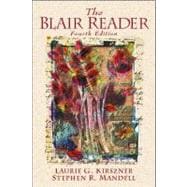
The Blair Reader

ISBN: 9780130910660 | 013091066X
Edition: 4th
Format: Paperback
Publisher: Prentice Hall
Pub. Date: 1/1/2002

Why Rent from Knetbooks?

Because Knetbooks knows college students. Our rental program is designed to save you time and money. Whether you need a textbook for a semester, quarter or even a summer session, we have an option for you. Simply select a rental period, enter your information and your book will be on its way!

Top 5 reasons to order all your textbooks from Knetbooks:

  • We have the lowest prices on thousands of popular textbooks
  • Free shipping both ways on ALL orders
  • Most orders ship within 48 hours
  • Need your book longer than expected? Extending your rental is simple
  • Our customer support team is always here to help
SummaryTable of Contents

THE BLAIR READER offers 114 essays, seven poems, and two short stories arranged thematically under ten interesting and thought-provoking topics (e.g., Family and Memory, The Politics of Language, The American Dream, and The Wired Revolution).

NEW FEATURES:

  • Thirty-seven new selections highly-rated by faculty reviewers to encourage critical inquiry
  • Photographic images with reflective thinking questions in every chapter
  • End-of-chapter Internet research activities for further disco... MORE

COMPANION WEBSITE? www.prenhall.com/kirszner

The Companion Website provides additional chapter exercises, links, and activities that reinforce and build upon the material presented in the text.

Website features include:
? Additional essay and short answer questions for every reading
? Web links that provide additional contextual information
? Web destinations for each essay topic
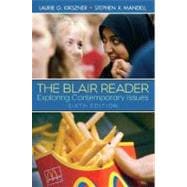


For first-year composition courses. This thematic reader offers provocative readings, discussion questions, and writing assignments designed to appeal to students with varied backgrounds and reading levels. Easy to use in the classroom and accessible and engaging for students, this text encourages them to think critically and to make their own contributions through discussion and writing about issues that shape the world.

(*Denotes new selection.)
1. Family and Memory.

Hayden, “Those Winter Sundays” (poetry). Soto, “One Last Time.” White, “Once More to the Lake.” Kingston, “No Name Woman.” Momaday, “The Way to Rainy Mountain.” Walker, “Beauty: When the Other Dancer Is the Self.” Carver, “My Father's Life.” Focus: How Has Divorce Redefined the Family? Hoffman, “The Perfect Family.” Kingsolve... MORE

2. Issues in Education.
*Holt, “School Is Bad for Children.” *Plato, “Myth of the Cave.” Twain, “Reading the River.” Whitman, “When I Heard the Learn'd Astronomer.” Barry, “The Sanctuary of School.” Angelou, “Graduation.” Kozol, “Savage Inequalities.” *Staples, “Why Colleges Shower Their Students with A's.” Zinsser, “College Pressures.” Henry, “In Defense of Elitism.” Focus: What Is The Real Purpose of Education? *Brown, “Who Cares about the Renaissance?” *Shatzman, “When Learning Hurts.” Edmundson, “On the Uses of a Liberal Education.”

3. The Politics of Language.
Douglass, “Learning to Read and Write.” Malcolm X, “A Homemade Education.” *Lawrence, “Four-Letter Words Can Hurt You.” Tan, “Mother Tongue.” Kozol, “The Human Cost of an Illiterate Society.” *Hayakawa, “Reports, Inferences, Judgments.” Nilsen, “Sexism in English: Embodiment and Language (updated in 2000).” Orwell, “Politics and the English Language.” Focus: Should English Be the Law? *Rodriguez, “Aria.” King, “Should English Be the Law?” Amselle, “Ingles Si!”

4. Media and Society.
Winn, “Television: The Plug-In Drug.” McGrath, “Giving Saturday Morning Some Slack.” *Saltzman, “Celebrity Journalism, the Public, and Princess Diana.” Steinem, “Sex, Lies, and Advertising.” *Dettmar, “Grasping the Dark Images of Rock.” *Tuttle, “Television and African Americans.” Iyer, “The Global Village Finally Arrives.” Kaminer, “Testifying: Television.” Focus: Does Media Violence Hurt? Grisham, “Unnatural Killers.” *Rhodes, “Hollow Claims about Fantasy Violence.” *Leo, “When Life Imitates Video.”

5. Gender and Society.
Piercy, “Barbie Doll” (poetry). Olds, “Rites of Passage (poetry).” *Woolf, “Professions for Women.” Sanders, “The Men We Carry in Our Minds.” Brady, “Why I Want a Wife.” *Hochschild, “The Second Shift.” Gutmann, “Sex and the Soldier.” Tannen, “Marked Women.” Focus: Who Has It Harder, Women or Men? *Whitehead, “The Girls of Gen X.” *Sommers, “The War against Boys.” Faludi, “The Future of Men.”

6. The American Dream.
Chief Seattle, “We May Be Brothers.” *De Toqueville, “Why the Americans Are so Restless in the Midst of Their Prosperity.” Wright, “The Library Card.” Mukherjee, “American Dreamer.” Cofer, “The Myth of the Latin Woman.” Staples, “Just Walk on By.” Eighner, “On Dumpster Driving.” Hurston, “How it Feels to Be Colored Me.” Lawrence and Matsuda, “The Telltale Heart: Apology, Reparation, and Redress.” Focus: What Is the American Dream? Jefferson, The Declaration of Independence. *Lazarus, “The New Colossus” (poetry). *Kennedy, Inaugural Address. King, “I Have a Dream.”

7. The Wired Revolution.
*Dunn, “Two View of Technology's Promise.” *Negroponte, “An Age of Optimism.” *Thomas, “Computers.” Rawlins, “Pregnant with Possibility.” Gup, “The End of Serendipity.” *Kuriloff, “If John Dewey Were Alive Today, He'd Be a Webhead.” *Elmer-DeWitt, “Bards of the Internet.” *Postman, “Informing Ourselves to Death.” Focus: Is There Equality in Cyberspace? *Gates, “One Internet, Two Nations.” *Span, “Women and Computers.” *Symonds, “Government and the Internet: Haves and Have-Nots.”

8. Medicine and Human Values.
Tuchman, “The Black Death.” Selzer, “Imelda.” Gordon, “What Nurses Stand For.” *Sanger, “The Turbid Ebb and Flow of Misery.” Goodall, “A Plea for the Chimps.” Seaver, “My World Now.” *Thomas, “Do Not Go Gentle into That Good Night” (poetry). Kübler-Ross, “On the Fear of Death.” *Borosage, “Misplaced Priorities: A Focus on Guns.” Focus: Whose Life Is It Anyway? Schneiderman, “The Ethics of Euthanasia.” Kervorkian, “A Case of Assisted Suicide.” Carter, “Rush to a Lethal Judgment.”

9. Nature and the Environment.
Chief Seattle, “Letter to President Pierce.” Gore, “The Wasteland.” *Forster, “My Wood.” Carson, “The Obligation to Endure.” Rathje and Murphy, “Recycling: No Panacea.” *Purdy, “Shades of Green.” Christensen, “Is a Tree Worth a Life?” *Boyle, “Top of the Food Chain” (fiction). Focus: Who Owns the Land? Peterson, “Growing Up Game.” Quindlen, “Our Animal Rites.” Ehrenreich, “The Myth of Man as Hunter.” Stafford, “Traveling Through the Dark” (poetry).

10. Making Choices.
Frost, “The Road Not Taken” (poetry). Pastan, “Ethics” (poetry). Dillard, “The Deer at Providencia.” Orwell, “Shooting an Elephant.” Thoreau, “Civil Disobedience.” King, “Letter from Birmingham Jail.” Harden, “Lifeboat Ethics.” McCarthy, “Dog Lab.” *Koch, “Death and Justice.” *Feingold, “The Need for a Moratorium on Executions.” Milgram, “The Perils of Obedience.” Sagan, “The Rules of the Game.” *LeGuin, “The Ones Who Walk Away from Omelas” (fiction). Focus: Are All Ideas Created Equal? Krauss, “Equal Time for Nonsense.” *Eldridge, “Creationism Isn't Science.” Lipstadt, “Denying the Holocaust.” *Tremblay, “Revising Our Prejudices: The Holocaust and Freedom of Speech.”

Credits.
Index.

Related Products


  • Blair Reader, The, with NEW MyCompLab with eText -- Access Card Package
    Blair Reader, The, with NEW My...
  • Blair Reader, The: Exploring Issues and Ideas
    Blair Reader, The: Exploring I...
  • The Blair Reader
    The Blair Reader
  • The Blair Reader
    The Blair Reader
  • The Blair Reader
    The Blair Reader
  • The Blair Reader Exploring Issues and Ideas
    The Blair Reader Exploring Iss...
  • The Blair Reader with NEW MyCompLab -- Access Card Package
    The Blair Reader with NEW MyCo...


Please wait while this item is added to your cart...