FREE SHIPPING BOTH WAYS
ON EVERY ORDER!
LIST PRICE:
$54.40

OUR PRICE:
$26.93

You may extend rentals at any time.


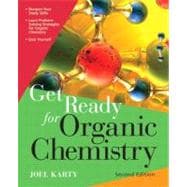
Get Ready for Organic Chemistry

ISBN: 9780321774125 | 0321774124
Edition: 2nd
Format: Paperback
Publisher: Prentice Hall
Pub. Date: 10/19/2011

Why Rent from Knetbooks?

Because Knetbooks knows college students. Our rental program is designed to save you time and money. Whether you need a textbook for a semester, quarter or even a summer session, we have an option for you. Simply select a rental period, enter your information and your book will be on its way!

Top 5 reasons to order all your textbooks from Knetbooks:

  • We have the lowest prices on thousands of popular textbooks
  • Free shipping both ways on ALL orders
  • Most orders ship within 48 hours
  • Need your book longer than expected? Extending your rental is simple
  • Our customer support team is always here to help
SummaryTable of Contents
Get Ready for Organic Chemistry takes a unique approach to preparing students for one of the most challenging courses in the undergraduate curriculum by emphasizing fundamental chemical concepts and helping students develop a productive mindset for studying Organic Chemistry. The Second Edition offers new learning tools within the text and online to further student understanding and promote retention of key Organic principles. Available for an online course through MasteringChemistry , Get Ready for Organic Chemistry can also be discounted when... MORE
... MORE
Prefacep. vi
Why do most Students Struggle with Organic Chemistry?p. 1
Introductionp. 1
How Organic Chemistry Is Differentp. 1
The Wrong Strategyp. 2
The Right Strategyp. 4
Organization and Goals of the Bookp. 6
Features of This Bookp. 7
Lewis dot Structures and the Chemical Bondp. 9
Introductionp. 11
Lewis Dot Structuresp. 11
Formal Chargep. 16
Resonancep. 20
Application: Drawing Lewis Structures of Complex Molecules Quicklyp. 25
Application: Draw All Resonance Contributors of...p. 27
Application: Shorthand Notationsp. 36
What Did You Learn?p. 41
Molecular Geometry, Dipole Moments, and Intermolecular Interactionsp. 44
Introductionp. 46
VSEPR Theory and Three-Dimensional Molecular Geometryp. 46
Tetrahedral Geometry and the Dash-Wedge Notationp. 52
Rotations about Single and Double Bondsp. 56
Bond Dipoles and Polarityp. 58
Intermolecular Interactionsp. 64
Application: cis and trans Isomersp. 76
Application: Melting Point and Boiling Point Determinationp. 78
Application: Solubilityp. 81
What Did You Learn?p. 85
Isomerismp. 88
Introductionp. 90
Isomers: A Relationshipp. 90
Constitutional Isomerismp. 91
Stereoisomerism: Enantiomers and Diastereomersp. 95
Physical and Chemical Behavior of Isomersp. 106
Application: Index of Hydrogen Deficiency (Degree of Unsaturation)p. 108
Application: Draw All Constitutional Isomers of...p. 112
Application: Draw All Stereoisomers of...p. 116
What Did You Learn?p. 120
Reaction Mechanisms 1: Elementary Stepsp. 122
Introductionp. 124
Bond Formation (Coordination) and Bond Breaking (Heterolysis)p. 125
Proton Transfersp. 131
Bimolecular Nucleophilic Substitution (SN2)p. 133
Nucleophilic Addition and Eliminationp. 134
Electrophilic Addition and Eliminationp. 137
Carbocation Rearrangementsp. 139
Bimolecular Elimination (E2)p. 140
Application: Simplifying Assumptions about Electron-Rich and Electron-Poor Sitesp. 141
Application: Stereochemistry of Reactions and the Production of a New Stereocenterp. 146
Application: Stereospecificity of SN2 Stepsp. 149
What Have You Learned?p. 151
Charge Stability: Charge is Bad!p. 156
Introductionp. 158
Atomic Ionsp. 158
Molecular Ionsp. 161
Resonance Effectsp. 161
Inductive Effectsp. 163
Putting It All Togetherp. 168
Application: Strengths of Acids and Basesp. 170
Application: Strengths of Nucleophiles and the Hammond Postulatep. 177
Application: Solvent Effects on Nucleophile Strengthp. 182
Application: The Best Resonance Contributorp. 189
What Did You Learn?p. 191
Reaction Mechanisms 2: SN1 and E1 Reactions and Rules of Thumb for Multistep Mechanismsp. 193
Introductionp. 195
Elementary Steps as Part of Multistep Mechanisms: SN1 and E1 Reactionsp. 195
Consequences of Single-Step Versus Multistep Mechanismsp. 200
Proton Transfers as Part of Multistep Mechanismsp. 204
Molecularity of Elementary Stepsp. 210
Application: Tautomerization Reactions-Neutral, Acidic, and Basic Conditionsp. 211
Application: Dealing with Relatively Lengthy Mechanisms-Fischer Esterification and Imine Formationp. 215
What Did You Learn?p. 220
SN1/SN2/E1/E2 Reactions: The Whole Storyp. 224
Introductionp. 227
Rate-Determining Steps: Rate Laws and the Role of the Attacking Speciesp. 228
Factor #1: Strength of Attacking Speciesp. 232
Factor #2: Concentration of Nucleophile/Basep. 233
Factor #3: Stability of the Leaving Groupp. 235
Factor #4: Type of Carbon Atom Bonded to the Leaving Groupp. 237
Factor #5: Solvent Effectsp. 240
Substitution Versus Eliminationp. 241
Sample Problems-Putting It All Togetherp. 244
What Did You Learn?p. 253
Concluding Remarks-What Now?p. 256
Solutions to Selected End-of-Chapter Problemsp. 258
Indexp. 275
Table of Contents provided by Ingram. All Rights Reserved.

Related Products


  • Outlines and Highlights for Principles of Biochemistry by Horton, Isbn : 0131453068
    Outlines and Highlights for Pr...
  • Principles Of Biochemistry
    Principles Of Biochemistry
  • Principles of Biochemistry
    Principles of Biochemistry
  • Principles of Biochemistry, Nuts and Bolts of Organic Chemistry, The: A Student's Guide to Success, and Biochemistry Student Companion
    Principles of Biochemistry, Nu...
  • Study Guide for Principles of Biochemistry
    Study Guide for Principles of ...
  • The Nuts and Bolts of Organic Chemistry A Student's Guide to Success
    The Nuts and Bolts of Organic ...


Please wait while this item is added to your cart...