FREE SHIPPING BOTH WAYS
ON EVERY ORDER!
LIST PRICE:
$156.60

OUR PRICE:
$17.74

You may extend rentals at any time.


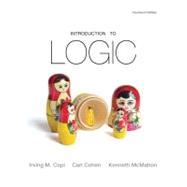
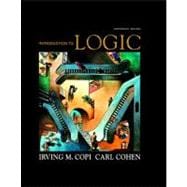
Introduction to Logic

ISBN: 9780205820375 | 0205820379
Edition: 14th
Format: Hardcover
Publisher: Pearson
Pub. Date: 11/11/2010

Why Rent from Knetbooks?

Because Knetbooks knows college students. Our rental program is designed to save you time and money. Whether you need a textbook for a semester, quarter or even a summer session, we have an option for you. Simply select a rental period, enter your information and your book will be on its way!

Top 5 reasons to order all your textbooks from Knetbooks:

  • We have the lowest prices on thousands of popular textbooks
  • Free shipping both ways on ALL orders
  • Most orders ship within 48 hours
  • Need your book longer than expected? Extending your rental is simple
  • Our customer support team is always here to help
SummaryTable of ContentsAuthor Biography
The 14th Edition of Introduction to Logic, written by Copi, Cohen & McMahon, Is dedicated To The many thousands of students and their teachers - at hundreds of universities in the United States and around the world - who have used its fundamental methods and techniques of correct reasoning in their everyday lives.   To those who have not previously used or reviewed Introduction to Logic we extend the very warmest welcome.  Please join us and our international family of users!  Let us help you teach students the methods and principles needed in ... MORE

Foreward

Preface

Acknowledgments


PART I  LOGIC AND LAGUAGE


SECTION A  REASONING


Chapter 1     Basic Logical Concepts

1.1 What Logic Is

1.2 Propositions and Arguments

... MORE

1.4 Arguments and Explanations

1.5 Deductive and Inductive Arguments

1.6 Validity and Truth


Chapter 2    Analyzing Arguments

2.1 Paraphrasing Arguments

2.2 Diagramming Arguments

2.3 Complex Argumentative Passages

2.4 Problems in Reasoning


SECTION B INFORMAL LOGIC


Chapter 3    Language and Definitions

3.1 Language Functions

3.2 Emotive Language, Neutral Language, and Disputes

3.3 Disputes and Ambiguity

3.4 Definitions and Their Uses

3.5 The Structure of Definitions: Extension and Intension

3.6 Definition by Genus and Difference


Chapter 4      Fallacies

4.1 What Is a Fallacy?

4.2 Classification of Fallacies

4.3 Fallacies of Relevance

4.4 Fallacies of Defective Induction

4.5 Fallacies of Presumption

4.6 Fallacies of Ambiguity


Part II  Deduction


Section A     Classical Logic


Chapter 5      Categorical Propositions

5.1 The Theory of Deduction

5.2 Classes and Categorical Propositions

5.3 The Four Kinds of Categorical Propositions

5.4 Quality, Quantity, and Distribution

5.5 The Traditional Square of Opposition

5.6 Further Immediate Inferences

5.7 Existential Import and the Interpretation of Categorical Propositions

5.8 Symbolism and Diagrams for Categorical Propositions


Chapter 6      Categorical Syllogisms

6.1 Standard-Form Categorical Syllogisms

6.2 The Formal Nature of Syllogistic Argument

6.3 Venn Diagram Technique for Testing Syllogisms

6.4 Syllogistic Rules and Syllogistic Fallacies

6.5 Exposition of the Fifteen Valid Forms of the Categorical Syllogism

Appendix: Deduction of the Fifteen Valid Forms of the Categorical Syllogism


Chapter 7      Syllogisms in Ordinary Language

7.1 Syllogistic Arguments

7.2 Reducing the Number of Terms to Three

7.3 Translating Categorical Propositions into Standard Form

7.4 Uniform Translation

7.5 Enthymemes

7.6 Sorites

7.7 Disjunctive and Hypothetical Syllogisms

7.8 The Dilemma


Section B    Modern Logic


Chapter 8      Symbolic Logic

8.1 Modern Logic and Its Symbolic Language

8.2 The Symbols for Conjunction, Negation, and Disjunction

8.3 Conditional Statements and Material Implication

8.4 Argument Forms and Refutation by Logical Analogy

8.5 The Precise Meaning of “Invalid” and “Valid”

8.6 Testing Argument Validity Using Truth Tables

8.7 Some Common Argument Forms

8. 8 Statement Forms and Material Equivalence

8.9 Logical Equivalence

8.10 The Three “Laws of Thought”


Chapter 9      Methods of Deduction

9.1  Formal Proof of Validity

9.2  The Elementary Valid Argument Forms

9.3  Formal Proofs of Validity Exhibited

9.4  Constructing Formal Proofs of Validity

9.5  Constructing More Extended Formal Proofs

9.6  Expanding the Rules of Inference: Replacement Rules

9.7  The System of Natural Deduction

9.8  Constructing Formal Proofs Using the Nineteen Rules of Inference

9.9  Proof of Invalidity

9.10 Inconsistency

9.11 Indirect Proof of Validity

9.12 Shorter Truth-Table Technique


Chapter 10     Quantification Theory

10.1 The Need for Quantification

10.2 Singular Propositions

10.3 Universal and Existential Quantifiers

10.4 Traditional Subject—Predicate Propositions

10.5 Proving Validity

10.6 Proving Invalidity

10.7 Asyllogistic Inference


Part III  Induction


Section A    Analogy and Causation


Chapter 11       Analogical Reasoning

11.1 Induction and Deduction Revisited

11.2 Argument by Analogy

11.3 Appraising Analogical Arguments

11.4 Refutation by Logical Analogy


Chapter 12     Causal Reasoning

12.1  Cause and Effect

12.2  Causal Laws and the Uniformity of Nature

12.3  Induction by Simple Enumeration

12.4  Methods of Causal Analysis

12.5  Limitations of Inductive Techniques


Section B    Science and Probability


Chapter 13       Science and Hypothesis

13.1 Scientific Explanation

13.2 Scientific Inquiry: Hypothesis and Confirmation

13.3 Evaluating Scientific Explanations

13.4 Classification as Hypothesis


Chapter 14     Probability

14.1     Alternative Conceptions of Probability

14.2     The Probability Calculus

14.3     Probability in Everyday Life


Appendix


Solutions to Selected Exercises


Glossary/Index

Irving M. Copi was a philosopher and logician. He taught at the University of Illinois, the United States Air Force Academy, Princeton University, and the Georgetown University Logic Institute, before teaching logic at the University of Michigan, 1958-69, and at the University of Hawaii, 1969-90. His other works include Essentials of Logic, Informal Logic, and Symbolic Logic.


Carl Cohen is Professor of Philosophy at the Residential College of the University of Michigan. He has published many essays in moral and political philosophy in philosophical, medical, and legal journals. He has served as a member of the Medical School faculty of the University of Michigan, and as Chairman of the University of Michigan faculty, where he has been an active member of the philosophy faculty since 1955. His other works include The Animal Rights Debate (Rowman and Littlefield, 2001), with Prof. Tom Regan; he is also the author of Democracy (Macmillan, 1972); the author of Four Systems (Random House, 1982); the editor of Communism, Fascism, and Democracy (McGraw Hill, 1997); the co-author (with J. Sterba) of Affirmative Action and Racial Preference (Oxford, 2003)


Kenneth D. McMahon studied physics, philosophy, and English Literature as an undergraduate, then took graduate degrees in psychology and philosophy.  He has taught critical thinking, philosophy, statistics, and  psychology, and currently teaches logic for Hawaii Pacific University.  His professional interests include logic, epistemology, philosophy of science, and philosophy of mind, as well as cognitive science, psychometrics, computational theories of mind, and evolutionary psychology.

Related Products


  • Outlines and Highlights for Introduction to Logic - Text Only by Irving M Copi, Isbn : 9780136141396
    Outlines and Highlights for In...
  • Introduction to Logic
    Introduction to Logic
  • Introduction to Logic
    Introduction to Logic
  • Introduction to Logic
    Introduction to Logic
  • Introduction to Logic
    Introduction to Logic
  • MyLogicLab Pegasus Student Access Code Card for Introduction to Logic (standalone)
    MyLogicLab Pegasus Student Acc...
  • Introduction to Logic
    Introduction to Logic
  • Introduction to Logic
    Introduction to Logic
  • Introduction to Logic
    Introduction to Logic
  • INTRO TO LOGIC & ELOGIC EXERCISES CD PKG, 12/e
    INTRO TO LOGIC & ELOGIC EXERCI...


Please wait while this item is added to your cart...