FREE SHIPPING BOTH WAYS
ON EVERY ORDER!
LIST PRICE:
$130.66

Sorry, this item is currently unavailable.

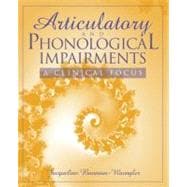
Articulatory and Phonological Impairments : A Clinical Focus
ISBN: 9780205402489 | 0205402488
Edition: 2nd
Format: Hardcover
Publisher: Allyn & Bacon
Pub. Date: 1/1/2004

Why Rent from Knetbooks?

Because Knetbooks knows college students. Our rental program is designed to save you time and money. Whether you need a textbook for a semester, quarter or even a summer session, we have an option for you. Simply select a rental period, enter your information and your book will be on its way!

Top 5 reasons to order all your textbooks from Knetbooks:

  • We have the lowest prices on thousands of popular textbooks
  • Free shipping both ways on ALL orders
  • Most orders ship within 48 hours
  • Need your book longer than expected? Extending your rental is simple
  • Our customer support team is always here to help
SummaryTable of ContentsAuthor Biography
Updated fully in its Second Edition, Articulatory and Phonological Impairments provides students with a clinical framework that encompasses basic terms and concepts, phonetic transcription, and theoretical perspectives extensively applied to clinical examples. This text demonstrates a systematic transition from a knowledge base in clinical practice to the diagnosis and treatment of individuals with articulatory/phonological disorders. While this text offers a thorough discussion of phonetic principles (also known as the traditional or motor app... MORE

All chapters include a “Chapter Outline,” “Summary,” and “References.”

Preface.

1. Clinical Framework: Basic Terms and Concepts.
Articulation and Articulation Disorders.
Phonetics and Its Relationship to Articulation Disorders.
Speech Sounds versus Phonemes: Clinical Application.
Phonology and Phonological Disorders.
Phonetics versus Phonology: Form and Function.
Articulation Disorders and Phonological Disorders.

2. Articulat... MORE
Vowels versus Consonants.
American English Vowels.
American English Consonants.
Sounds in Context: Coarticulation and Assimilation.
Syllable Structure.

3. Phonetics Transcription and Diacritics.
Phonetic Transcription as a Notational System.
Why Use Phonetic Transcription?
Diacritics.
Clinical Implications.

4. Theoretical Considerations.
Phonology.
Distinctive Feature Theories.
Generative Phonology.
Natural Phonology.
Linear versus Nonlinear Phonologies.

5. Normal Phonological Development.
Aspects of Structural and Functional Development.
Aspects of Perceptual Development.
Prelinguistic Stages: Before the First Word.
Transition from Babbling to First Words.
The First Fifty Words.
Segmental Development.
Prosodic Development.
The Preschool Child.
Segmental Development: Vowels and Consonants.
Phonological Processes.
Prosodic Feature Development.
Developmental Issues: Natural Phonology versus Nonlinear Phonology.
The School-Age Child.
Segmental Form Development.
Learning to Speak and Learning to Read.
Prosodic Feature Development

6. Appraisal: Collection of Data.
Evaluation by the Clinician.
Initial Impression.
Articulation Tests.
Spontaneous Speech Sample.
Evaluation of the Speech Mechanism.
Selection of Additional Assessment Measures.
Special Considerations.
The Child with Emerging Phonology.
The Unintelligible Child.
The Dialect Speaker.
The Speaker of English as a Second Language.
Summary of the Data.

7. Diagnosis: Phonetic versus Phonemic Emphasis.
Preliminary Analysis: Inventory and Distribution of Speech Sounds.
Decision-Making: Primarily Phonetic Emphasis.
Additional Testing and Decisions.
Guidelines for Beginning Therapy.
Decision-Making: Primarily Phonemic Emphasis.
Inventory and Distribution of Speech Sounds.
Syllable Shapes and Constraints.
Phonological Contrasts.
Phonological Error Patterns.
Measures of Severity and Intelligibility.

8. Therapy for Phonetic Errors.
Decision Making: When to Use a Phonetic Approach.
Therapy Sequence.
Individual Sound Errors.
Misarticulations of: s-sounds, sh-sounds, k- and g-sounds, l-sounds, r-sounds including central vowels with r-coloring, th-sounds.
Phonetic Description.
Frequency of Occurrence, Phonotactics, Morphophonemic Function, and Minimal Pairs.
Types of Misarticulations.
Diagnostic Considerations.
Therapeutic Suggestions: Phonetic Placement and Sound Modification Methods.
Coarticulatory Conditions.
Word Examples.
Other Sound Errors.
Voicing Problems, Misarticulations of f- and v-Sounds, Affricates, and Consonant Clusters.
Phonetic Description.
Misarticulations.
Therapeutic Suggestions: Phonetic Placement and Sound Modification Methods.
Coarticulatory Conditions.
Word Examples.
Types of Misarticulations.

9. Treatment of Phonemic Errors.
Treatment Principles.
Minimal Pair Contrast Therapies.
Distinctive Feature Therapy. Minimal Opposition Contrasts. Maximal Opposition Training. Phonological Process Therapy.
Cycles Training.
Metaphon Therapy.
Phonemic Disorders with Concurrent Language Problems.
Therapeutic Suggestions.
The Child with an Emerging Phonological System.
Therapeutic Suggestions.
Treatment of Multiple Vowel Errors.

10. Articulatory/Phonological Disorders in Selected Populations.
Development Apraxia of Speech: A Disorder of Speech motor Control.
Motor Speech Disorders: Cerebral Palsy.
Clefting: Cleft Palate and Cleft Lip.
Mental Disability.
Hearing Impairment.
Motor Speech Disorders: Acquired Apraxia of Speech.
Motor Speech Disorders: The Dysarthrias.

Glossary.

References.

Index.

Jacqueline Bauman-Waengler is a professor in the department of Communicative Disorders at the University of Redlands, California.

Related Products


  • Articulation and Phonological Impairments : A Clinical Focus
    Articulation and Phonological ...
  • Articulatory and Phonological Impairments : A Clinical Focus
    Articulatory and Phonological ...
  • Articulatory and Phonological Impairments : A Clinical Focus
    Articulatory and Phonological ...


Please wait while this item is added to your cart...