FREE SHIPPING BOTH WAYS
ON EVERY ORDER!
LIST PRICE:
$71.40

Sorry, this item is currently unavailable.

Along These Lines : Writing Paragraphs and Essays
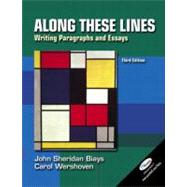
ISBN: 9780131112193 | 0131112198
Edition: 3rd
Format: Paperback
Publisher: Prentice Hall
Pub. Date: 1/1/2004

Why Rent from Knetbooks?

Because Knetbooks knows college students. Our rental program is designed to save you time and money. Whether you need a textbook for a semester, quarter or even a summer session, we have an option for you. Simply select a rental period, enter your information and your book will be on its way!

Top 5 reasons to order all your textbooks from Knetbooks:

  • We have the lowest prices on thousands of popular textbooks
  • Free shipping both ways on ALL orders
  • Most orders ship within 48 hours
  • Need your book longer than expected? Extending your rental is simple
  • Our customer support team is always here to help
SummaryTable of Contents
For courses in Basic Writing, at the sentence to paragraph level or paragraph to essay level. Beginning writers need constant reinforcement of the stages of the writing process. Unlike other textswhich stop coverage of the writing process after a few chaptersthis book takes students through all the steps of the writing process from generating ideas, to planning, to drafting and revising, and editing in every chapter.

Writing Paragraphs and Essays

PART I: WRITING IN STEPS: THE PROCESS APPROACH.

1. Writing a Paragraph.
Beginning the Thought Lines: Gathering Ideas. Focusing the Thought Lines. Outlines: Devising a Plan for a Paragraph. Coherence: Putting Your Details in Proper Order. Rough Lines: Drafting and Revising a Paragraph. Final Lines: Proofreading and Polishing a Paragraph. Lines of Detail: A Walk-Through Assignment. Writing Your... MORE

2. Illustration.
What is Illustration? Writing the Illustration Paragraph in Steps. Lines of Detail: A Walk-Through Assignment. Writing Your Own Illustration Paragraph. Peer Review Form for an Illustration Paragraph. Writing From Reading: Illustration.
Spanglish, Janice Castro, with Dan Cook and Cristina Garcia.


3. Description.
What is Description? Writing the Description Paragraph in Steps. Lines of Detail: A Walk-Through Assignment. Writing Your Own Descriptive Paragraph. Peer Review Form for a Descriptive Paragraph. Writing From Reading: Description.
A Present for Popo, Elizabeth Wong.


4. Narration.
What is Narration? Writing the Narrative Paragraph in Steps. Lines of Detail: A Walk-Through Assignment. Writing Your Own Narrative Paragraph. Peer Review Form for a Narrative Paragraph. Writing From Reading: Narration.
Rocky Rowf, Edna Buchanan.


5. Process.
What is Process? Writing the Process Paragraph in Steps. Lines of Detail: A Walk-Through Assignment. Writing Your Own Process Paragraph. Peer Review Form for a Process Paragraph. Writing From Reading: Process.
How to Write a Personal Letter, by Garrison Keillor.


6. Comparison and Contrast.
What is Comparison? What is Contrast? Writing the Comparison or Contrast Paragraphs in Steps. Drafting and Revising. Lines of Detail: A Walk-Through Assignment. Writing Your Own Comparison or Contrast Paragraph. Peer Review Form for a Comparison or Contrast Paragraph. Writing From Reading: Comparison or Contrast.
Against All Odds, I'm Just Fine, by Brad Wackerlin.


7. Classification.
What is Classification? Writing the Classification Paragraph in Steps. Lines of Detail: A Walk-Through Assignment. Writing Your Own Classification Paragraph. Peer Review Form for Classification Paragraph. Writing From Reading: Classification.
Three Disciplines for Children, by John Holt.


8. Definition.
What is Definition? Writing the Definition Paragraph in Steps. Lines of Detail: A Walk-Through Assignment. Writing Your Own Definition Paragraph. Peer Review Form for a Definition Paragraph. Writing From Reading: Definition.
Breaking the Bonds of Hate, by Virak Khiev.


9. Cause and Effect.
What is Cause and Effect? Writing the Cause or Effect Paragraph in Steps. Lines of Detail: A Walk-Through Assignment. Writing Your Own Cause or Effect Paragraph. Peer Review Form for a Cause or Effect Paragraph. Writing From Reading: Cause or Effect.
Students in Shock, by John Kellmayer.


10. Argument.
What is Argument? Writing the Argument Paragraph in Steps. Lines of Detail: A Walk-Through Assignment. Writing Your Own Argument Paragraph. Peer Review Form for an Argument Paragraph. Writing From Reading: Argument.
Athletic Heroes, by James Beekman.


11. Writing an Essay.
What is an Essay? Writing the Introduction. Writing the Body of the Essay. Writing the Conclusion. Lines of Detail: A Walk-Through Assignment. Writing Your Own Essay. Peer Review Form for an Essay. Writing From Reading: The Essay.
Eleven, by Sandra Cisneros.


12. Different Essay Patterns.
Illustration. Writing the Illustration Essay in Steps. Writing an Illustration Essay. Description. Writing the Descriptive Essay in Steps. Writing a Descriptive Essay. Narration. Writing the Narrative Essay in Steps. A Narrative Essay. Process. Writing the Process Essay in Steps. Writing a Process Essay. Comparison and Contrast. Writing the Comparison or Contrast Essay in Steps. Classification. Writing the Classification Essay in Steps. Writing a Classification Essay. Definition. Writing the Definition Essay in Steps. Writing a Definition Essay. Cause and Effect. Writing a Cause or Effect Essay. Argument. Writing the Argument Essay in Steps. Writing an Argument Essay.

13. Writing From Reading.
What is Writing From Reading? An Approach to Writing From Reading. Writing a Summary of a Reading. Writing a Reaction to a Reading. Writing For an Essay Test. Lines of Detail: A Walk-Through Assignment. Writing Your Own Paragraph on "A Ridiculous Addiction." Peer Review Form For Writing From Reading. Writing From Reading.
My Daughter Smokes, by Alice Walker.
Parental Discussion, by Dennis Hevesi.


PART II: THE BOTTOM LINE: GRAMMAR FOR WRITERS.

14. The Simple Sentence.
Recognizing a Sentence. Recognizing Verbs. Recognizing Subjects. Prepositions and Prepositional Phrases. Word Order.

15. Beyond the Simple Sentence: Coordination.
Options for Combining Simple Sentences. Option 1: Using a Comma with a Coordinating Conjunction. Option 2: Using a Semicolon Between Two Simple Sentences. Option 3: Using a Semicolon and a Conjunctive Adverb.

16. Avoiding Run-On Sentences and Comma Splices.
Run-on Sentences. Steps For Correcting Run-On Sentences. Comma Splices. Correcting Comma Splices.

17. Beyond the Simple Sentence: Subordination.
More on Combing Simple Sentences. Option 4: Using a Dependent Clause to Begin a Sentence. Option 5: Using a Dependent Clause to End a Sentence.

18. Avoiding Sentence Fragments.
Recognizing Fragments: Step 1. Recognizing Fragments: Step 2. Correcting Fragments.

19. Using Parallelism in Sentences.
Achieving Parallelism.

20. Using Adjectives and Adverbs.
What are Adjectives? Adjectives: Comparative and Superlative Forms. What are Adverbs? Hints About Adjectives and Adverbs.

21. Correcting Problems with Modifiers.
Correcting Modifier Problems. Reviewing the Steps and the Solutions.

22. Using Verbs Correctly.
Using Standard Verb Forms. The Present Tense. The Past Tense. The Four Main Forms of a Verb: Present, Past, Present Participle, and Past Participle. Irregular Verbs.

23. More on Verbs: Consistency and Voice.
Consistent Verbs Tenses. The Present Perfect Tense. The Past Perfect Tense. Passive and Active Voice.

24. Making Subjects and Verbs Agree.
Pronouns as Subjects. Special Problems With Agreement. Compound Subjects. Indefinite Pronouns. Collective Nouns. Making Subjects and Verbs Agree: The Bottom Line.

25. Using Pronouns Correctly: Agreement and Reference.
Nouns and Pronouns. Agreement of a Pronoun and its Antecedent. Indefinite Pronouns. Collective Nouns. Pronouns and Their Antecedents: Being Clear.

26. Using Pronouns Correctly: Consistency and Case.
Choosing the Case of Pronouns. Common Errors With Case of Pronouns.

27. Punctuation: The Period and the Question Mark.
The Period. The Question Mark.

28. The Comma.
Use a Comma as a Lister. Use a Comma as a Linker. Use a Comma as an Introducer. Use a Comma as an Inserter.

29. Punctuation: The Semicolon and the Colon.
The Semicolon. The Colon.

30. Punctuation: The Apostrophe.
The Apostrophe.

31. Other Punctuation and Mechanics.
The Exclamation Mark. The Dash. Parenthesis. The Hyphen. Quotation Marks. Capital Letters. Numbers. Abbreviations.

32. Spelling.
Vowels and Consonants. Spelling Rule 1: Doubling a Final Consonant. Spelling Rule 2: Dropping the Final E. Spelling Rule 3: Changing the final y to i. Spelling Rule 4: Adding -s or -es. Spelling Rule 5: Using ie or ei. How Do You Spell It? One Word or Two? Commonly Misspelled Words.

33. Words That Sound Alike/Look Alike.
Words That Sound Alike/Look Alike. More Words That Sound Alike/Look Alike.

34. Word Choice.
Precise Language. Wordiness. Cliches.

35. Sentence Variety.
Balancing Long and Short Sentences. Using Different Ways to Begin Sentences. Using Different Ways to Join Ideas.

Appendix: Grammar for ESL Students.
Nouns and Articles.
Nouns or Pronouns Used as Subjects.
Verbs.
Contractions and Verbs.
Prepositions.
Credits.
Index.

Writing Paragraphs and Essays

Related Products


  • Along These Lines : A Course for Developing Writers
    Along These Lines : A Course f...
  • Along These Lines : Writing Paragraphs and Essays
    Along These Lines : Writing Pa...
  • Along These Lines : Writing Paragraphs and Essays
    Along These Lines : Writing Pa...
  • Along These Lines : Writing Paragraphs and Essays
    Along These Lines : Writing Pa...
  • Along These Lines : Writing Paragraphs and Essays (with MyWritingLab Student Access Code Card)
    Along These Lines : Writing Pa...
  • Along These Lines : Writing Paragraphs and Essays (with MyWritingLab Student Access Code Card)
    Along These Lines : Writing Pa...
  • Along These Lines : Writing Paragraphs and Essays (with MyWritingLab Student Access Code Card)
    Along These Lines : Writing Pa...
  • Along These Lines: Writing Paragraphs and Essays (Book Alone)
    Along These Lines: Writing Par...
  • MyWritingLab with Pearson eText -- Standalone Access Card -- for Along These Lines Writing Paragraphs and Essays
    MyWritingLab with Pearson eTex...


Please wait while this item is added to your cart...