Free Shipping On Every Order



Amazon no longer offers textbook rentals. We do!
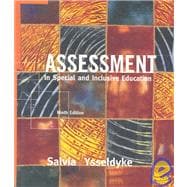
Assessment : In Special and Inclusive Education
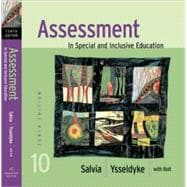
Assessment : In Special and Inclusive Education
- ISBN 13:
9780618692699
- ISBN 10:
061869269X
- Edition: 10th
- Format: Hardcover
- Copyright: 03/01/2006
- Publisher: Wadsworth Publishing
- Newer Edition
Rent
Sorry, this item is currently unavailable.
 Free Shipping On Every Order
Note: Supplemental materials are not guaranteed with Rental or Used book purchases.
Extend or Purchase Your Rental at Any Time
Need to keep your rental past your due date? At any time before your due date you can extend or purchase your rental through your account.
Summary
The market-leading professional resource in the field, this text offers basic assessment information and a handbook of actual reviews of the tests most often administered in K-12 schools. Assessment is recognized for its honest and even-handed reviews of common standardized tests administered by assessment personnel in the areas of achievement, intelligence, language, math, and reading. The text also helps teachers and school psychological personnel become more informed consumers and users of these tests. Comprehensive coverage includes both standardized (formal) and classroom (informal) assessment, such as portfolio assessment, outcome-based assessment, observation, ecological assessment, and teacher-made tests. New! Chapter 15, "How to Review a Test," takes readers through these steps: picking a test; understanding a test's purposes, content, procedures, and scores; evaluating a test's norms, reliability, and validity; and reaching a summary evaluation of a test. New! Part Five, "Decision Making," is created from a reorganization of the text and contains three substantially revised chapters--"Teacher Decision Making," "Making Entitlement Decisions," and "Making Accountability Decisions"--as well as one new chapter, "Assessing Response to Intervention." New! Chapter 30, "Assessing Response to Intervention (RTI)" discusses the fundamental assumptions in assessing RTI; definitions of RTI; measurement concepts in RTI models; dimensions of assessment of RTI; purposes of assessing RTI; examples of RTI assessment models; and issues and considerations. New and Significantly Revised! Test Reviews have been updated for currency in the Tenth Edition. Among the 23 new or updated tests are Asperger Syndrome Diagnostic Scale (ASDS), Comprehensive Mathematical Abilities Test, Group Mathematics Assessment and Diagnostic Evaluation, Bender Visual Motor Gestalt Test, Second Edition, and The Test of Early Mathematics Ability, Third Edition. All of the new and revised tests are indicated by an asterisk in the list of all tests reviewed in this edition, which appears on the inside front cover and first page of the book. This edition has been streamlined, with less frequently used tests now accessible on the Online Teaching and Study Centers. New! Up-to-date coverage includes IDEA legislation that proposes new ways to assess students with learning disabilities. An Epilogue, "The Evolution of Assessment Practices: Where Are We Headed?" offers an overview of the critical issues facing the future of the assessment field, and describes the new Problem-Solving Model as an approach for addressing assessment practices in schools.