FREE SHIPPING BOTH WAYS
ON EVERY ORDER!
LIST PRICE:
$44.99

OUR PRICE:
$35.63

You may extend rentals at any time.


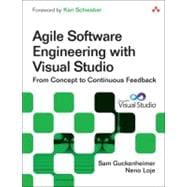
Agile Software Engineering with Visual Studio : From Concept to Continuous Feedback

ISBN: 9780321685858 | 0321685857
Edition: 2nd
Format: Paperback
Publisher: Addison-Wesley Professional
Pub. Date: 1/1/2012

Why Rent from Knetbooks?

Because Knetbooks knows college students. Our rental program is designed to save you time and money. Whether you need a textbook for a semester, quarter or even a summer session, we have an option for you. Simply select a rental period, enter your information and your book will be on its way!

Top 5 reasons to order all your textbooks from Knetbooks:

  • We have the lowest prices on thousands of popular textbooks
  • Free shipping both ways on ALL orders
  • Most orders ship within 48 hours
  • Need your book longer than expected? Extending your rental is simple
  • Our customer support team is always here to help
SummaryTable of ContentsAuthor Biography
Use Visual Studio® 2010 and Agile Methods to Deliver Higher-Value Software-Without Waste, Delays, or Pain!   Using Visual Studio® 2010, development teams can utilize agile methods to deliver higher-value software faster, systematically eliminating waste and inefficiency throughout the entire development lifecycle. Now, top Microsoft Visual Studio architect Sam Guckenheimer and leading Visual Studio implementation consultant Neno Loje show how to how to make the most of Microsoft's new Visual 2010 Application Lifecycle Management (ALM) tools in ... MORE

Sam Guckenheimer
When I wrote the predecessor of this book, I had been at Microsoft less than three years. I described my history like this:I joined


Microsoft in 2003 to work on Visual Studio Team System (VSTS), the new product line that was just released at the end of 2005. As the group product planner, I have played chief customer advocate, a role that I have loved. I have been in the IT industry for twenty-some years, spending most of my career as a tester, project manager, analyst, and developer.


As a tester, I’ve always understood the theoretical value of advanced developer practices, such as unit testing, code coverage, static analysis, and memory and performance profiling. At the same time, I never understood how anyone had the patience to learn the obscure tools that you needed to follow the right practices.


As a project manager, I was always troubled that the only decent data we could get was about bugs. Driving a project from bug data alone is like driving a car with your eyes closed and only turning the wheel when you hit something. You really want to see the right indicators that you are on course, not just feel the bumps when you stray off it. Here, too, I always understood the value of metrics, such as code coverage and project velocity, but I never understood how anyone could realistically collect all that stuff.


As an analyst, I fell in love with modeling. I think visually, and I found graphical models compelling ways to document and communicate. But the models always got out of date as soon as it came time to implement anything. And the models just didn’t handle the key concerns of developers, testers, and operations.


In all these cases, I was frustrated by how hard it was to connect the dots for the whole team. I loved the idea in Scrum (one of the Agile processes) of a “single product backlog”—one place where you could see all the work—but the tools people could actually use would fragment the work every which way. What do these requirements have to do with those tasks, and the model elements here, and the tests over there? And where’s the source code in that mix?


From a historical perspective, I think IT turned the corner when it stopped trying to automate manual processes and instead asked the question, “With automation, how can we reengineer our core business processes?” That’s when IT started to deliver real business value.


They say the cobbler’s children go shoeless. That’s true for IT, too. While we’ve been busy automating other business processes, we’ve largely neglected our own. Nearly all tools targeted for IT professionals and teams seem to still be automating the old manual processes. Those processes required high overhead before automation, and with automation, they still have high overhead. How many times have you gone to a 1-hour project meeting where the first 90 minutes were an argument about whose numbers were right?


Now, with Visual Studio, we are seriously asking, “With automation, how can we reengineer our core IT processes? How can we remove the overhead from following good process? How can we make all these different roles individually more productive while integrating them as a high performance team?”


Obviously, that’s all still true.


Neno Loje

I started my career as a software developer—first as a hobby, later as profession. At the beginning of high school, I fell in love with writing software because it enabled me to create something useful by transforming an idea into something of actual value for someone else. Later, I learned that this was generating customer value.


However, the impact and value were limited by the fact that I was just a single developer working in a small company, so I decided to focus on helping and teaching other developers. I started by delivering pure technical training, but the topics soon expanded to include process and people, because I realized that just introducing a new tool or a technology by itself does not necessarily make teams more successful.


During the past six years as an independent ALM consultant and TFS specialist, I have helped many companies set up a team environment and software development process with VS. It has been fascinating to watch how removing unnecessary, manual activities makes developers and entire projects more productive. Every team is different and has its own problems. I’ve been surprised to see how many ways exist (both in process and tools) to achieve the same goal: deliver customer value faster though great software.


When teams look back at how they worked before, without VS, they often ask themselves how they could have survived without the tools they use now. However, what had changed from the past were not only the tools, but also the way they work as a team.


Application Lifecycle Management and practices from the Agile Consensus help your team to focus on the important things. VS and TFS are a pragmatic approach to implement ALM (even for small, nondistributed teams). If you’re still not convinced, I urge you to try it out and judge for yourself.


Related Products


  • Software Engineering With Microsoft Visual Studio Team System
    Software Engineering With Micr...
  • Visual Studio Team Foundation Server 2012 : Adopting Agile Software Practices, from Backlog to Continuous Feedback
    Visual Studio Team Foundation ...


Please wait while this item is added to your cart...