 Free Shipping On Every Order



Amazon no longer offers textbook rentals. We do!
Trace Analysis of Specialty and Electronic Gases
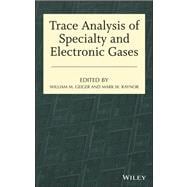
Trace Analysis of Specialty and Electronic Gases
- ISBN 13:
9781118065662
- ISBN 10:
1118065662
- Edition: 1st
- Format: Hardcover
- Copyright: 07/15/2013
- Publisher: Wiley
 Free Shipping On Every Order
List Price $127.94 Save $1.28
Print on Demand: 2-4 Weeks. This item cannot be cancelled or returned.
 We Buy This Book Back!
.svg "Free Shipping On Every Order") Free Shipping On Every Order
Free Shipping On Every Order
Note: Supplemental materials are not guaranteed with Rental or Used book purchases.
Extend or Purchase Your Rental at Any Time
Need to keep your rental past your due date? At any time before your due date you can extend or purchase your rental through your account.
Summary
Explores the latest advances and applications of specialty and electronic gas analysis
The semiconductor industry depends upon a broad range of instrumental techniques in order to detect and analyze impurities that may be present in specialty and electronic gases, including permanent gases, water vapor, reaction by-products, and metal species. Trace Analysis of Specialty and Electronic Gases draws together all the latest advances in analytical chemistry, providing researchers with both the theory and the operating principles of the full spectrum of instrumental techniques available for specialty and electronic gas analysis. Moreover, the book details the advantages and disadvantages of each technique, steering readers away from common pitfalls.
Featuring contributions from leading analytical and industrial chemists, Trace Analysis of Specialty and Electronic Gases covers a wide range of practical industrial applications. The book begins with the historical development of gas analysis and then focuses on particular subjects or techniques such as:
- Metals sampling and ICP-MS analysis
- Improvements in FTIR spectroscopy
- Water vapor analysis techniques
- New infrared laser absorption spectroscopy approaches
- GC/MS, GC/AED, and GC-ICP-MS techniques
- Gas chromatography columns
- Atmospheric pressure ionization mass spectrometry
Lastly, the book examines gas mixtures and standards that are critical for instrument calibration. There are also two appendices offering information on fittings and material compatibility.
With its thorough review of the literature and step-by-step guidance, Trace Analysis of Specialty and Electronic Gases enables researchers to take full advantage of the latest advances in gas analysis. Although the book's focus is the semiconductor and electronics industry, analytical chemists in other industries facing challenges with such issues as detection selectivity and sensitivity, matrix gas interference, and materials compatibility will also discover plenty of useful analytical approaches and techniques.


